Impact of Religious Trauma Series: The Unchaperoned Life | Post 3 of 6
She stopped letting him hug her.
Not because she didn't want to be held. She was desperate to be held. But every hug had become a down payment on something she hadn't agreed to — a transaction she could feel coming the moment his arms went around her. So she stopped initiating. Stopped leaning in. Started bracing instead of softening.
And then she felt guilty for that too.
If you recognize that story — if you've lived some version of it, in a marriage or in the relationships that came after — this article is for you. Not to fix you. Not to reframe your experience before you've had a chance to feel it fully. Just to say: what happened to you was real, it was wrong, and it makes complete sense that you're carrying it the way you are.
We'll get to the rest. But that comes first.
What She Was Taught About Her Own Body
If you grew up in LDS culture — or in any high-demand religious tradition that placed purity at the center of a young woman's worth — you received a very specific education about your body. It started early and it was relentless.
You may remember the lesson with the chewed gum. Or the board with nails hammered in, then pulled out — the holes that remained as evidence of what had been lost. Or the flower with its petals removed one by one. Or the piece of tape pressed to wrist after wrist until it wouldn't stick anymore. The metaphors varied by ward and by decade, but the message was always the same:
Your body is a sacred vessel. Its value is its purity. Once that purity is compromised, something is lost that cannot be fully restored.
Every woman I've spoken to from this background remembers some version of that lesson. And every one of them absorbed it not just as doctrine but as identity. You weren't just taught that sexual purity was important. You were taught that you were the purity. That your worth as a woman, a potential wife, a daughter of God, was inseparable from what you had and hadn't allowed.
That is an enormous weight to place on a young woman's shoulders. And it doesn't stay in the Young Women's classroom. It follows her into her marriage, into her bed, into every moment of physical closeness for the rest of her life — often in ways she can't fully articulate because she's never been given language for it.
What Marriage Was Actually Like
Here's what a lot of women from this background don't say out loud, even now:
The marriage they waited for — the covenant relationship that was supposed to make physical intimacy sacred and beautiful and safe — didn't feel that way.
It felt like being a body in a room with someone who needed something from it.
I've heard this described in so many ways by so many women, and the language is strikingly consistent: I felt like a tool. I felt like I wasn't there. He wasn't with me — he was using me to get somewhere. One woman told me she eventually realized her husband had learned everything he knew about physical intimacy from pornography — that he had trained her, essentially, to perform rather than connect, to pursue a specific outcome rather than be present with another person. She had never seen so much as a PG-13 movie. He had seen everything. And what that gap produced in their marriage was a profound loneliness — two people in the same bed, one of them completely alone.
Another woman told me she stopped wanting hugs. Not because she didn't crave physical affection — she was starving for it. But because every touch had a destination. Every moment of closeness was a prelude. There was no such thing as just being held. So she learned to live without being held, and called it fine, and carried the ache of it quietly for years.
These aren't unusual stories. They are, heartbreakingly, common ones.
The Wound That Didn't Get Treated
I want to tell you something about my sister, who has given me permission to tell this story because she believes it illustrates something that needs to be said plainly.
In the mid-1990s, my sister was raped.
She was young, working at a Blockbuster video store. A young man she knew asked if she wanted to come over and watch a video. She said yes — and took it literally. She brought four options.
What happened next wasn't what she agreed to. She didn't fully understand what had happened until it was over and she was sitting in silence, stunned, trying to make sense of what her body had just experienced. She hadn't consented. She had thought, with complete sincerity, that they were going to watch a movie.
She just felt numb afterward — she did not know how to process what had happened, but knew it wasn't right.
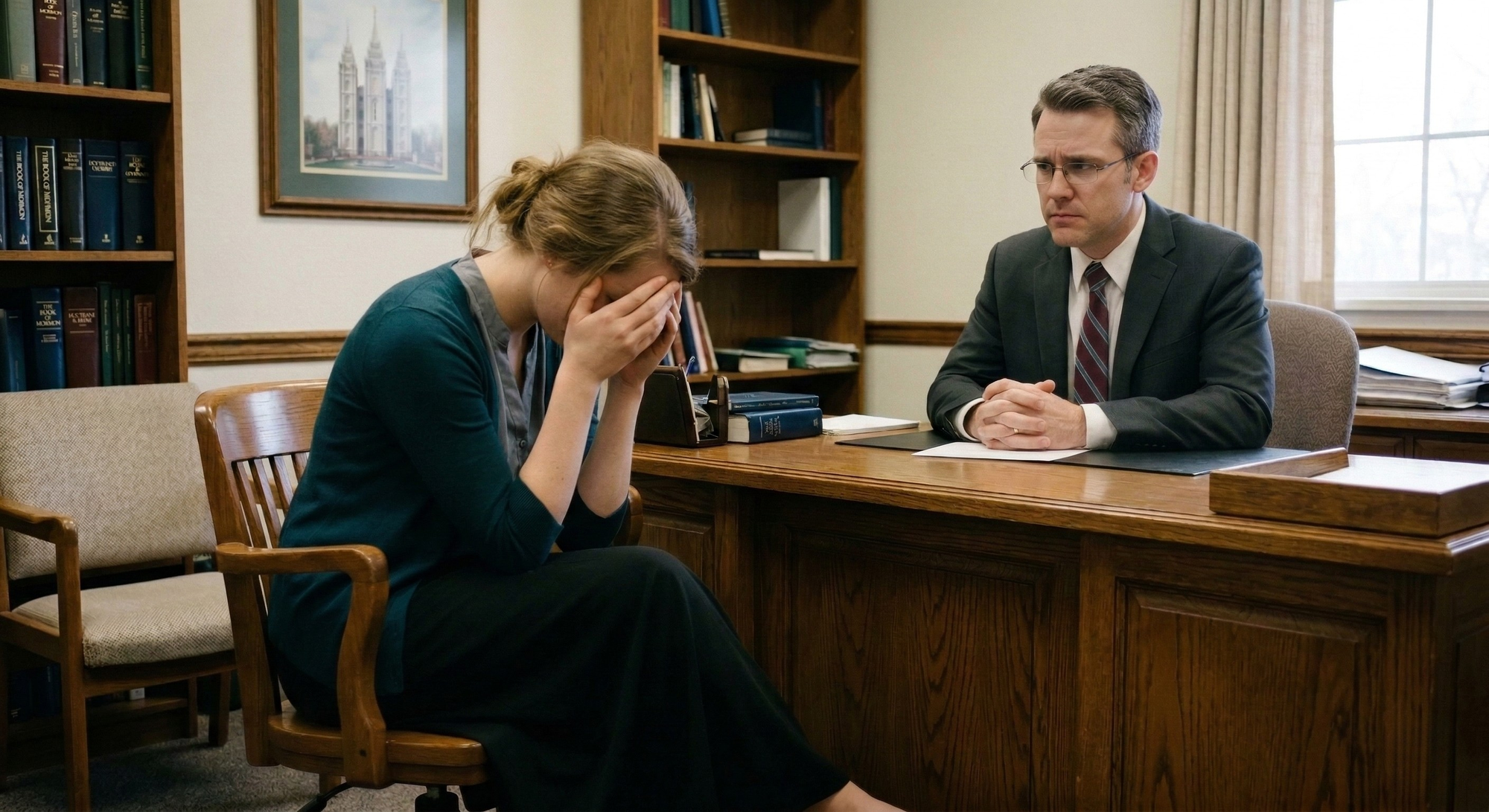
When she went to her bishop, she was in crisis. She needed someone to sit with her in that crisis. To say: what was done to you was wrong. You are not damaged. You are not at fault. You are loved.
What she got instead was a checklist – and guilt.
The bishop's first question was whether the boy was a member of the church — determining, before anything else, whether ecclesiastical discipline might be warranted for him. He wasn't. He wasn't a boy. He was 26. She was 16. And then came the questions about her. About what had happened. About her role in it.
Had she known they would be alone? Yes, she said.
Then, the bishop told her, it was her fault. She had, in his words, "blown through stop signs." She did because she had been so naïve. She believed the bishop– even if it didn't FEEL right to her.
My sister was placed on probation for being raped. The man who invited her over under false pretenses was the secondary concern. Her naïvety — the very innocence that purity culture had spent years cultivating in her — became the evidence of her guilt.
I want to be clear about something: the bishop in that room was not a cruel man. He was a man following a protocol he had been given, in an era when the language of consent barely existed in secular culture, let alone religious culture. He was doing what he had been trained to do. And what he had been trained to do was find the sin and address it — not find the wound and tend it.
That is the indictment. Not of him personally. Of a framework that, at its worst, turned a traumatized young woman into a disciplinary matter.
My sister carried that for years. And she is not alone. Across this community, there are women who were shamed for what was done to them, women who internalized the church's response as confirmation of what the purity lessons had already taught them: your body's compromise is your fault, your loss, your burden.
If that is your story — in whole or in part — I want to say directly: that response was wrong. What happened to you deserved compassion, not a checklist. And the shame you were handed was never yours to carry.
What Happens After Divorce
Many women from this background enter post-divorce dating carrying all of this — the purity lessons, the marriage that didn't honor them, the shame that was never properly addressed — and then encounter something that breaks them open all over again.
They meet someone. There's genuine connection. Real warmth. Feelings they haven't felt in years, maybe ever. And eventually, there's physical intimacy — entered into with hope, with vulnerability, with the full emotional investment that women from this background bring to physical closeness because that's how they were wired. For them, allowing someone in physically is allowing someone in completely. It is not casual. It is not separate from the heart.
And then he goes cold.
Maybe it's a slow fade. Maybe it's a weekend of genuine connection followed by texts that get shorter and further apart. Maybe it's more sudden — the warmth simply gone, replaced by distance she can't explain and he won't.
And she is left with the feeling she feared most.
I gave something precious. It wasn't received as precious. I was used.
That feeling is real. It deserves to be honored, not argued with. And before we say anything else, I want to say that clearly: if this has happened to you, your pain is legitimate. Your sense that something was taken without being fully understood or valued — that is not an overreaction. That is an accurate reading of something that genuinely went wrong.
What's Actually Happening — And Why It Isn't What You Think
Here's where I want to offer something carefully, because I'm not interested in excusing behavior that leaves women feeling abandoned and invisible. I am interested in helping you understand what's actually happening — because understanding it leads somewhere useful, and staying only in the wound does not.
Most men from this background who pursue physical intimacy and then disappear are not predators. They are not calculating. They are not consciously taking something they have no intention of honoring.
They were handed two scripts. And both of them are wrong.
Script one is the one the priesthood manuals favor: you are the head of the household. Lead, provide, preside. It produces men who manage their families rather than connect with them. Men who feel responsible for their wife's happiness but have no idea how to actually ask about her inner life. Men who experience a woman's emotional needs as a problem to be solved rather than a person to be known.
Script two is the one that sounds better but isn't: serve your wife. Make her happy. Be a good, selfless priesthood holder. This one produces what author Robert Glover calls the Nice Guy — a man who has suppressed his own needs and desires so completely in the name of keeping the peace that he has no authentic self left in the relationship. Just a performance of selflessness. And underneath it, quietly, resentment.
Neither script teaches a man how to be present. Neither teaches him to be genuinely curious about his wife's interior world. Neither teaches him to be vulnerable himself — to say I'm scared or I don't know how to do this or I need something I don't know how to ask for. When a woman tries to open that door — when she asks him what he's actually feeling — he goes defensive or shuts down. Not because he's withholding. Because he genuinely doesn't know what's behind that door. Nobody taught him to open it. Some men don't even know it exists.
Ask a group of LDS men to sit in a circle and talk honestly about their emotional lives and watch what happens. The discomfort is almost physical. The training runs deep: emotions are private, vulnerability is weakness, and a man who doesn't have answers is a man who has failed. They were taught to perform competence. They were never taught that not knowing — and saying so — is actually the most connective thing a man can do.
So they stay silent. They shut down when asked. They reach for physical closeness because it's the one language they were given for feeling connected — and then they wonder why she doesn't feel known.
Here's the harder thing to say, and I'll say it from personal experience because I think it matters:
Some men — men who have done enough of their own work to actually be present, to listen without fixing, to offer genuine emotional attunement — become extraordinarily powerful in women's lives. Not because they're exceptional. Because the bar has been so low for so long that basic presence feels like a revelation.
I've been told, more than once, that I'm dangerous in this way. That I offer women something they've never experienced from a man — the feeling of being truly seen, truly heard, truly there with. And that feeling is so foreign, so startling, so far outside anything they thought was available, that they don't just feel connected- they fall in love with the presence itself.
That's both a gift and a risk worth naming. Because a woman who has never been truly seen before may not be falling in love with the person providing the presence. She may be falling in love with the experience of being seen — which she has been starving for her entire life. The distinction matters for both people involved.
But here's what that dynamic reveals about the rest: if basic emotional presence is rare enough to feel miraculous, something has gone very wrong in how this culture prepared men for partnership. The problem isn't that men are malicious. The problem is that they are relationship illiterate — and the church, which spends considerable energy preparing men to lead and provide, has historically spent very little preparing them to connect.
That's not an excuse. It's an explanation. And the difference matters.
Being used implies intent — someone who knew exactly what they were taking and took it anyway. Being on the receiving end of someone's emotional illiteracy is different. It's painful in a different way, and it leads to different questions. Not how do I protect myself from men like him — though discernment has its place — but was this person actually capable of being present with me? And how do I find someone who is?
What the Chewed Gum Lesson Got Wrong
I want to come back to those lessons for a moment, because they did something specific that is still showing up in the lives of women in this community decades later.
They located the wound in the woman's body.
The gum, the nails, the petals, the tape — in every metaphor, she is the thing that is damaged. Her purity is what is lost. The lesson was never about connection, or presence, or what it means to be truly known by another person. It was about preservation. About keeping something intact so it could be properly offered at the right time to the right person.
What that framework missed entirely is that intimacy isn't about what you bring to someone. It's about what you build with someone. It isn't a resource that gets depleted. It's a capacity that grows — when it's honored, when it's mutual, when both people are actually present with each other.
The damage isn't in the intimacy. The damage is in the absence of presence. In being physically close to someone who isn't actually there. In giving your full self to a moment that the other person is only partially inhabiting.
That's what leaves women feeling used. Not the intimacy itself. The absence of the presence that intimacy is supposed to carry.
Elder Jeffrey R. Holland, in Of Souls, Symbols, and Sacraments, described physical intimacy as "a symbol of total union" — the most complete offering of self to another person. It's a beautiful vision. And it points, inadvertently, to exactly what is missing when intimacy feels like violation rather than gift: the total union part. The full presence. The genuine offering of self, not just body.
When that's present, intimacy heals. When it's absent, intimacy wounds. And the work — for both men and women from this background — is learning to tell the difference before the moment arrives, not after.
What You Actually Deserve
You deserve to be held without it being a transaction.
You deserve physical affection that has no destination — that exists simply because someone wants to be close to you, not because closeness is a path to something else.
You deserve a partner who is curious about your interior life, not just your body. Who asks questions and actually listens to the answers. Who can sit with your pain without trying to fix it or flee from it. Who knows the difference between being present with you and performing presence for you.
You deserve intimacy that feels like being known.
That's not too much to ask. It's actually the baseline. And if your history — in marriage, in the church, in post-divorce relationships — has taught you that it is too much to ask, that's the thing worth examining. Not your standards. The story that said those standards were unreasonable.
A Note to the Men Reading This
If you've read this far, something landed. Maybe you recognized yourself — in the shutdown, in the performance, in the gap between what you offered and what she actually needed. Maybe you've been the man whose physical closeness meant one thing while hers meant something entirely different, and you genuinely didn't understand until it was too late.
That recognition is the beginning of something.
Here's what I want to say to you directly: the women in your life are not asking you to be someone you're not. They're asking you to stop performing someone you are. There's a version of you underneath the scripts — underneath the Nice Guy and the patriarch and the priesthood holder — who actually has an interior life. Who is scared sometimes. Who doesn't know things and would benefit enormously from saying so.
That version of you is what she's been looking for.
You don't have to have all the answers. You don't have to perform emotional fluency you haven't built yet. But you do have to be willing to learn — to read the books, go to the workshops, sit in the therapist's office, have the conversations that feel dangerously vulnerable. Not because she's demanding it. Because you deserve to know yourself that well.
Asking for help doesn't make you look like an idiot. Staying stuck because you were too proud to ask — that's what costs you everything.
The woman this article is written for has been waiting a long time for a man who is actually in the room with her. The question worth sitting with isn't whether she's asking too much.
It's whether you're ready to show up.
Unchaperoned Life exists for people who are done performing worthiness — and ready to find out what love actually looks like when it's built on something real.
Next: "Part 4: I Wasn't Ready Either — And That's the Part Many of Us Have a Hard Time Admitting"