There's a moment that happens on a lot of first dates that nobody talks about.
Two reasonably decent humans sit across from each other. Both are a little nervous. Both are secretly hoping this one might be different. Both are also — if they're honest — waiting for the other shoe to drop.
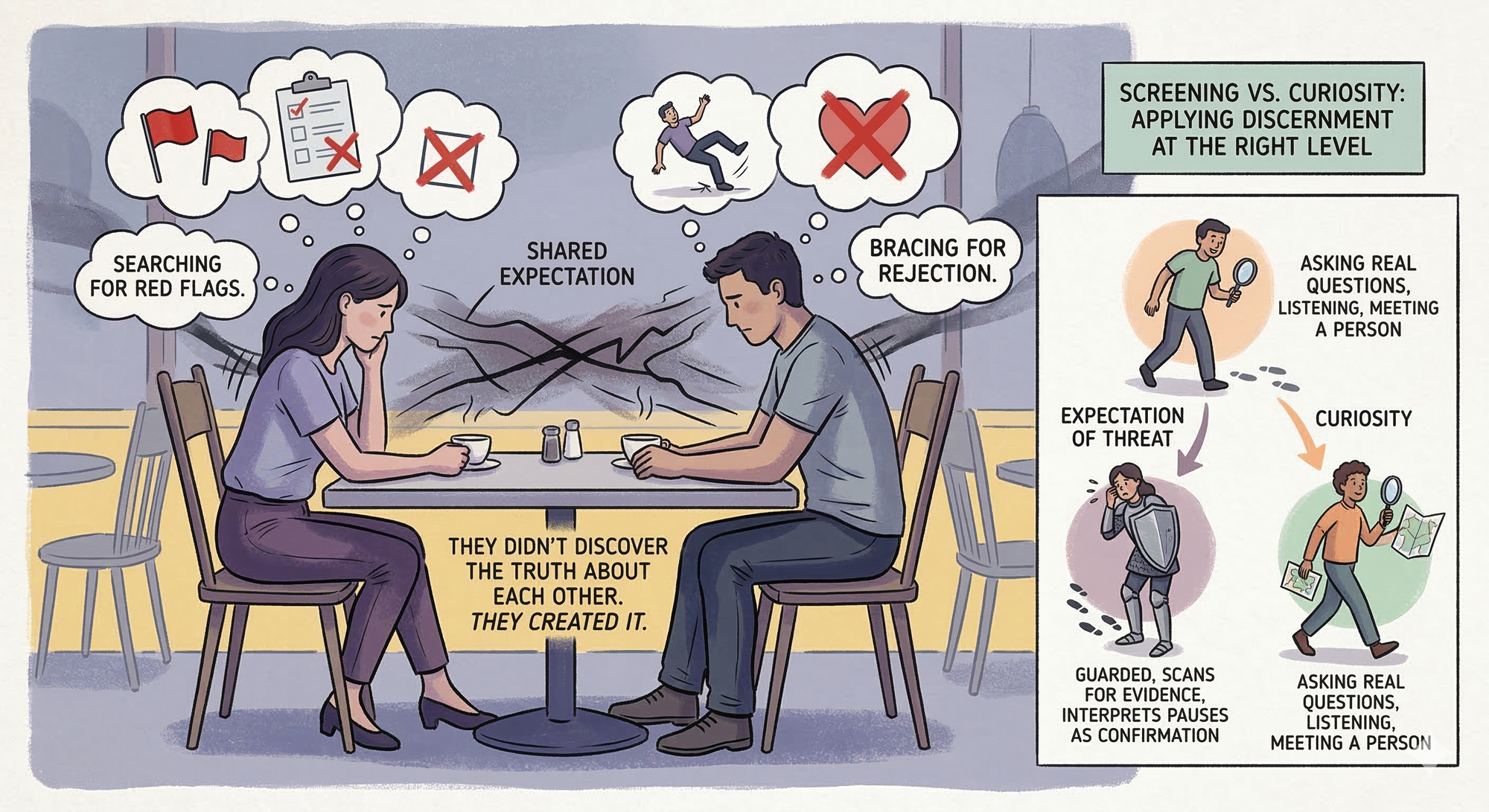
She's watching for red flags. He's pre-bracing for rejection. And somehow, before the food even arrives, they've both confirmed exactly what they were afraid of.
Here's the thing: they didn't discover the truth about each other. They created it.
Your Expectation Is Part of the Room
When you walk into a situation expecting a threat, your whole nervous system prepares for battle. You get guarded. You scan for evidence. You interpret every slightly awkward pause as confirmation that your instincts were right.
And that energy? The person across from you can feel it — even if they can't name it.
The woman who's quietly auditing every word for warning signs makes a nervous guy more stilted and careful. Which reads as evasive. Which feels like a red flag.
The guy who's already half-apologizing with his whole body language for being a man makes a woman feel like something's off. Which makes her more guarded. Which makes him more awkward.
They've co-created the experience they were both dreading — together, before dessert.
This isn't about lowering your standards. It's about recognizing that your expectation is part of the environment you're both walking into. You're not just observing the date. You're shaping it.
The Ticket vs. The Concert
Here's a distinction that actually makes this easier:
Values alignment is your entry ticket. Curiosity is how you show up once you're inside.
Knowing that you both want a committed relationship — or that you're both just open and exploring — isn't pressure. It's just not wasting each other's Saturday night. You can establish basic directional alignment in a profile, in a first conversation, before you ever sit down together.
Once you're actually on the date? Your only job is to be genuinely interested in the human across from you.
The mistake most people make — especially people from backgrounds where relationships carried a lot of spiritual and social weight — is applying checklist energy to the wrong things. They confirm the big stuff (great) and then also require the right job, the right height, the right response time on texts, the right vibe from the way someone holds their fork.
Suddenly every first date is a performance review with eternal stakes.
A lot of that checklist, if you look closely, wasn't even yours to begin with. It was inherited — from your upbringing, your community, the version of yourself that was 22 and following a script someone else wrote.
The invitation is to be clear about the few things that genuinely can't bend, and genuinely curious about everything else. Because here's what most people discover when they actually relax: some of what they thought they needed wasn't that important, and some of what they never thought to look for turns out to matter enormously.
The "Chill" Trap
Now for the honest part.
A lot of midlife singles — especially those who've had relationships end painfully, or who gave a lot and felt used, or who watched a long-term commitment fall apart despite doing everything "right" — arrive at dating with a very reasonable strategy:
Stay chill. Stay open. But don't get your hopes up.
And on the surface, that sounds healthy. Low expectations, low stakes, no pressure.
But there's a version of "chill" that's actually something else: it's having a hidden ejector seat. You're present enough to enjoy the connection, but protected enough that if it falls apart, you can say "well, I wasn't really all in anyway."
That's not low stakes. That's defended ambivalence wearing the costume of maturity.
And people feel it — even when they can't name it. There's a quality of withheld that makes real connection impossible, because real connection requires at least some willingness to actually show up and be seen.
The question worth sitting with isn't "should I want a relationship?" It's: Is my 'chill' protecting me, or protecting me from something I actually want?
There's a real difference between genuine openness with low attachment — where you're curious, present, and okay either way — and defended ambivalence, where you're quietly making sure you can never really get hurt.
Both look almost identical from the outside. Only you know which one it is.
What Actually Helps
None of this means abandoning discernment. It means applying it at the right level.
- Before the date: Be clear about direction. What are you actually looking for right now? What genuinely can't you compromise on? Get honest about that — with yourself first, then with who you're talking to.
- On the date: Let all of that go for two hours. Just meet a person. Be curious. Ask real questions. Listen like the answer actually matters to you.
- After the date: Then check in. Did your values feel aligned? Did you feel respected? Did the conversation feel real?
That's the sequence. Screening isn't about interrogating someone over appetizers — it's something that happens naturally when two people are actually talking to each other like humans.
Most people sitting across from you on a first date are carrying some version of the same fear you are. A little history, a little hope, a little armor they're not quite sure how to take off.
The date gets better the moment one of you decides to just be a person.
It might as well be you.