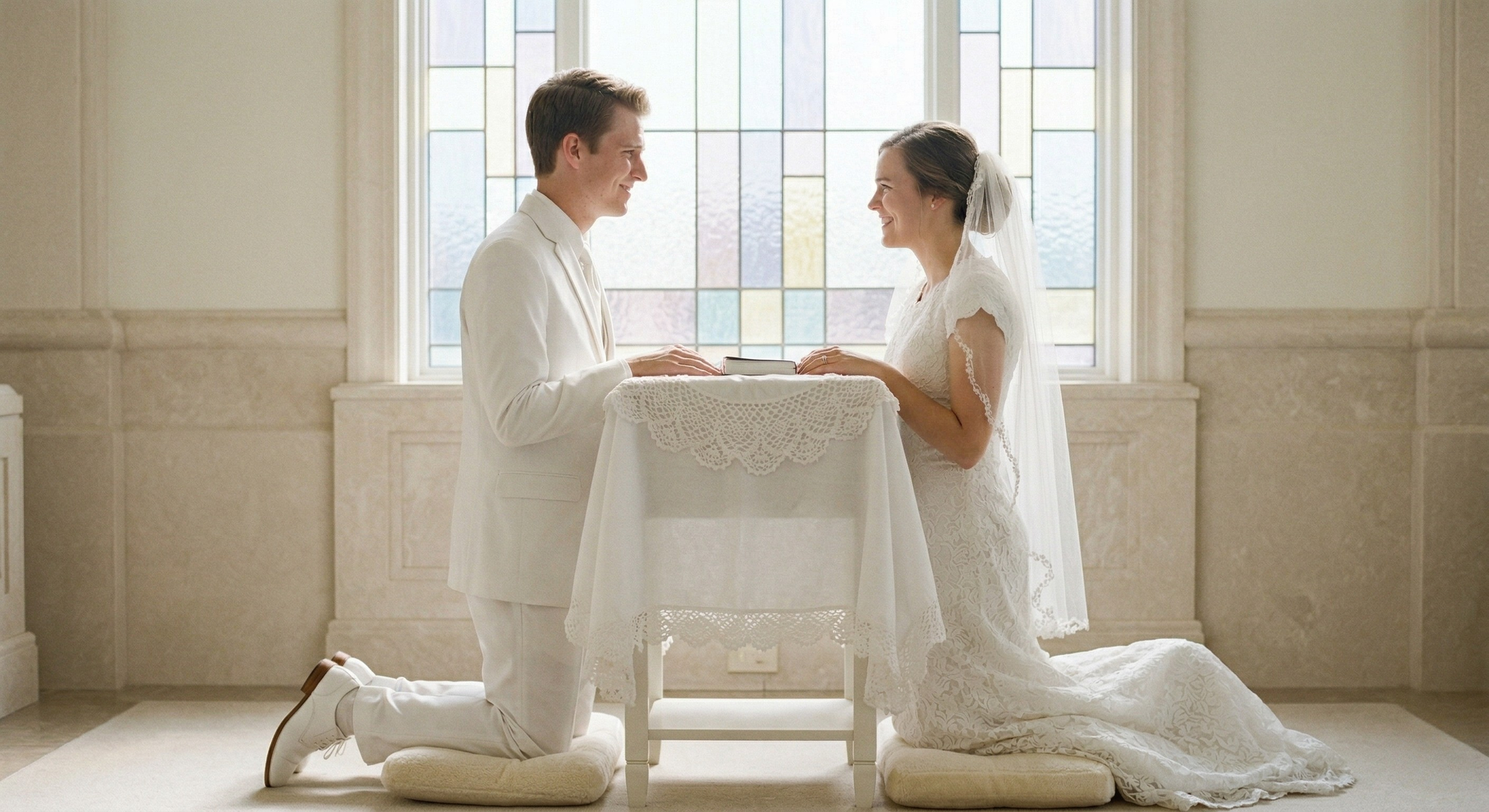
There is a version of this story that plays out quietly, without drama, in thousands of LDS homes. No affairs. No cruelty. No villain. Just two young people who got married because everyone around them made it feel like the only reasonable next step, and who then spent the next decade or two slowly becoming strangers to each other.
This is that story. And if you grew up in the church, you probably know it by heart. You may have lived it.
The Setup Nobody Questions
He had just come home from his mission. Two years of structure, purpose, and identity as a representative of the Lord. He was 21, on fire for the gospel, and suddenly back in a world where the next clearly marked milestone was getting married in the temple.
She had been waiting. Not just for him specifically, though they had written letters. She had been waiting the way young women in the church are quietly taught to wait, for the righteous returned missionary who would take her to the temple and start the eternal family she had been preparing for since Primary.
Their mothers thought they were perfect for each other. The ward thought they were perfect for each other. The cultural script thought they were perfect for each other.
Neither of them had stopped to ask whether they thought they were perfect for each other.
The Knot Nobody Talked About
There was a moment, somewhere between the ring and the reception, where something felt slightly off. Not wrong exactly. More like a hesitation that didn't have a name.
He wasn't sure, if he was being completely honest, that what he felt for her was love in the way he had imagined love would feel. She was kind and faithful and everything a righteous woman was supposed to be. He cared about her. He did not want to hurt her. But there was a question living somewhere underneath all of that, one he could not ask out loud because there was no good answer to it in the framework he had been given.
She had her own quiet uncertainty. Physical intimacy frightened her. Not because of anything specific that had happened, but because she had grown up understanding her body as something to be protected and guarded and only surrendered to a husband. Now that the husband was real and the wedding night was approaching, she did not quite know how to make the transition from protected to present. She went into the marriage hoping the ceremony would somehow unlock what she couldn't yet access.
It didn't work quite that way.
But they went ahead. Because the invitations had been sent. Because their mothers were crying with joy. Because this was what you did when you were faithful and the timing was right and someone good was standing in front of you.
The Slow Fade
The trouble with a marriage that begins without urgency is that it also ends without urgency. There is no explosion. No single moment you can point to and say, that was when it broke. Just a long, quiet series of small distances that compound over years.
The physical intimacy that started cautiously stayed cautious. She never quite got comfortable. He never quite knew how to close the distance without feeling like he was asking for something she didn't want to give. So he stopped asking as often. Then mostly stopped. Then they had a rhythm that was less like a marriage and more like a very committed roommate situation, warm on the surface and quietly empty underneath.
They were kind to each other. That is the part people on the outside never understood later, when things fell apart. There was no fighting. No contempt. No cruelty. Just two people who had agreed, without ever using those words, to stop reaching for each other.
He threw himself into work and callings and the thousand small responsibilities of building a life. She threw herself into the children and the ward and the friendships that gave her the connection she wasn't finding at home. They were busy. They were good parents. They showed up to all the right things.
They just stopped showing up for each other.
What the Framework Got Wrong
The theology of eternal marriage, as it is often taught, treats the commitment as the destination. You work toward the temple, you make the covenant, and the hard part is over. What follows is meant to be a blessing, a reward for righteousness.
What it does not prepare you for is the very human reality that a covenant does not create chemistry. Faithfulness does not generate desire. Two people who were not quite sure they were choosing each other freely will eventually feel the weight of that uncertainty pressing on everything.
It also does not give you much language for what to do when the marriage is not abusive, not dramatic, not obviously broken. Just quietly hollow. The ecclesiastical advice for that situation tends to be the same as for harder ones: pray more, serve more, be more patient, trust that love is a choice and keep choosing it.
He chose it for a long time. She did too. But at some point choosing starts to feel less like love and more like endurance. And endurance has a limit.
The Conversation That Finally Happened
It was not a fight. It was more like an exhale that had been held too long.
He said something like: I don't think either of us chose this the way we should have been allowed to. I think we did what we were supposed to do and somewhere along the way forgot to ask what we actually wanted.
She cried. Not because she disagreed. Because she did agree, and agreeing meant that all the years of trying had not been enough to fix something that maybe had not been quite right from the beginning.
They had not failed at marriage. They had succeeded at something else entirely, at being responsible and faithful and present, and had called it a marriage when maybe it needed a different name.
For some couples that conversation eventually happens. Two adults who find the words, sit across from each other, and finally say what has been true for years. Those are the lucky ones.
More often, the marriage ends a different way.
He has gone years without feeling wanted. Not just physically, though that is part of it, but in the deeper way that a person needs to feel like they matter to someone. He does not leave. He would never say he is the kind of man who would do what he eventually does. But the distance gets long enough, and the loneliness gets loud enough, and something gives. Maybe it is a friendship that becomes something else. Maybe it is a screen at midnight that becomes a habit he cannot explain and cannot stop. Maybe it is just a slow drift away from the faith, from the community, from the version of himself he promised to be.
She finds out. And what she feels is not just betrayal, which would be devastating enough on its own. It is betrayal stacked on top of years of loneliness she had quietly normalized. She had already been alone in the marriage. Now she has proof that she was right to feel that way, and the proof is something she cannot unknow.
She does not get credit for the years she held it together. She does not get an acknowledgment that she was already hurting before this happened. What she gets is the story, told by everyone around her, of a husband who strayed and a marriage that failed. The part where she had been reaching toward someone who wasn't quite there for a decade rarely makes it into that version.
What This Story Costs
Whether the ending is traumatic betrayal or the ending is quieter than a dramatic rupture with no villain or clear wound, the cost is painful and real.
He arrives at midlife with the feeling that he has never been fully chosen by someone who genuinely wanted him, not just someone who decided he was the right next step. He is not sure he knows what that would feel like. He is not sure his body would even recognize it if it arrived.
She arrives at midlife carrying a quiet question about herself, wondering whether the desire that never quite showed up in her marriage was about the marriage or about her. She wonders whether she was somehow missing something or whether she simply needed a different kind of safety than the one she was offered at twenty-two.
Both of them walk away fundamentally decent people who did their best inside a structure that was not built for who they actually were. And both of them walk into new relationships carrying that history without fully knowing it is there.
What This Makes Midlife So Complicated
When these two people eventually land in the dating pool at forty-five or fifty, the old patterns surface in new ways.
He is cautious about commitment in a way that looks like fear but is really more like exhaustion. He has done the marriage. He did it faithfully. He is not sure he has another one in him, not because he is selfish but because the last one cost him something he hasn't finished accounting for yet.
She wants a real connection this time, the kind she suspects she was always supposed to have, and she is trying to figure out whether what she is looking for even exists or whether she has been chasing something the framework she grew up in simply didn't have room for.
When they find each other, which they do, often, in exactly the communities where people from this background tend to land, there is real recognition. A relief that someone else understands the specific weight of this. And then, not long after, the old patterns start showing up uninvited.
He pulls back a little when things get serious. She interprets it as rejection. He doesn't know how to explain that it is not about her. She doesn't know how to explain that what looks like pressure is really just the sound of someone who has waited a long time to finally want something and finally feel allowed to say so.
What Both Stories Are Really About
This story, and the harder one it sits beside, are both about the same thing underneath.
They are about what happens when people are asked to make the most intimate commitments of their lives inside a framework that does not leave much room for honest uncertainty. For the quiet voice that says I am not sure. For the time and space to actually choose.
The men who hesitate at commitment in midlife are not all broken. Some of them are men who followed every instruction they were ever given and still ended up somewhere that felt like a long, quiet loss of something they could never quite name.
The women who push for commitment are not all desperate. Some of them are women who gave everything they had to a marriage that felt, from the inside, like reaching toward someone who kept almost being there.
Neither of them is asking for too much. Neither of them is the problem. They are both carrying the weight of a system that asked a great deal of them and did not always give them the tools to carry it with their whole selves intact.
If You Recognize This Story
If you were that young man at the altar, not quite sure and going ahead anyway, the question worth sitting with now is not whether you made a mistake. You did the best you could with the framework you had. The question is whether you are letting that old story make decisions for you today, in a present where you actually have the freedom to choose differently.
If you were that young woman, hoping the covenant would unlock what you couldn't quite access, the desire that felt absent then does not mean it isn't in you. It may just mean it needed a different kind of safety than the one you were offered at twenty-two.
The work for both of you is the same. Not erasing what happened. Not pretending it was fine. But getting honest about what you carried out of it, so you can set down the parts that were never yours to carry in the first place.
That is what starting over actually looks like. Not a clean slate. A clearer one.
Unchaperoned Life exists for people who did everything right and still ended up here. If this resonated, you are not alone and you are not too far gone. The work starts when you are ready.