Impact of Religious Trauma Series: The Unchaperoned Life | Post 5 of 6
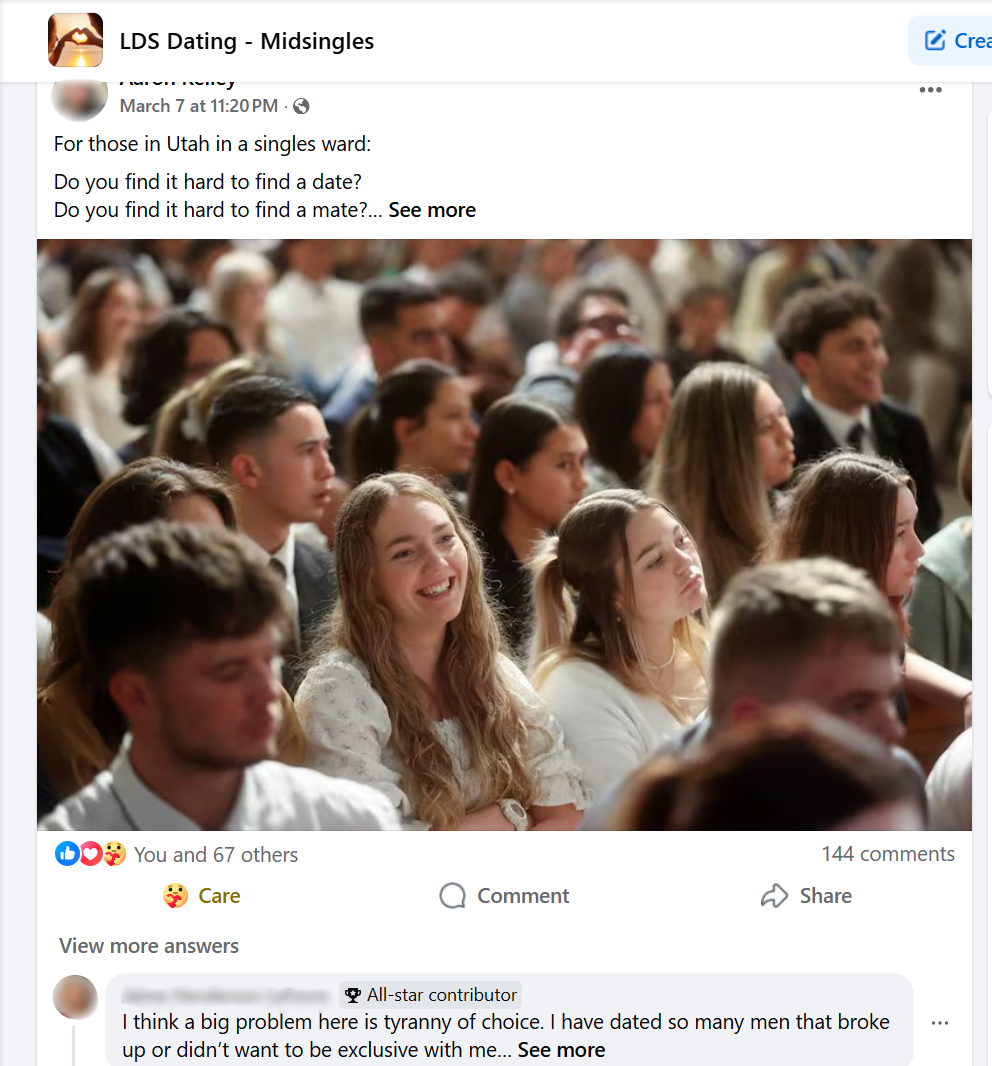
A woman in an online discussion about LDS singles dating put it simply and perfectly:
"I think a big problem here is tyranny of choice. I have dated so many men that broke up or didn't want to be exclusive with me for someone else, and then a year later tried to come back after the grass wasn't greener. Sometimes the more choices someone has, the pickier they get. Apps have made dating feel like there are endless choices and a lot of people don't stop looking even when they have someone great."
A man in the same thread replied:
"I've had women tell me, 'you're a unicorn, as good a guy as I've ever seen' — yet they want to see all that's out there. Then they are single. Always."
And then he said something that deserves to be read slowly:
"When people break up, they don't heal, they don't work on themselves. They think: there are so many people, someone will take me. I'm hurting and lonely, so I can find someone to love me even though I'm broken."
That last part isn't a criticism. It's a diagnosis. And it's one of the most honest descriptions of what's actually happening in midlife LDS dating — and in modern dating broadly — that I've come across.
We have more options than any generation in human history. We are lonelier than almost any generation in human history. Those two facts are not a coincidence.
The Numbers Are Worse Than You Think
Let's start with what the data actually shows, because it reframes the experience of both men and women in ways that matter for this conversation.
Researchers who analyzed Tinder swiping behavior found something striking: women swipe right — indicating interest — on roughly 4.5% of men. Men swipe right on about 61.9% of women. The result is a profound asymmetry that shapes every experience on the app. The top 78% of women on the platform are, in effect, competing for the attention of the top 20% of men. Which means the average woman on a dating app isn't experiencing a scarcity of options — she's experiencing an overwhelming surplus of them, most of which she doesn't want.
Chris Williamson, whose Modern Wisdom podcast has explored this data extensively, described it plainly: the bottom 80% of men are competing for the bottom 22% of women. Most men are largely invisible on these platforms. Most women are drowning in low-quality attention they never asked for.
Both experiences are miserable. And both, in different ways, make genuine connection harder rather than easier.
For women, the surplus creates what psychologists call choice overload — a well-documented phenomenon where having more options produces not better decisions, but worse ones. When your inbox has forty men in it, no single man feels scarce, feels precious, feels worth the risk of being wrong about. There's always another one. The cost of saying no to someone feels negligible. The cost of saying yes feels enormous, because what if the next one is better?
For men, the invisibility creates a different kind of damage — the quiet accumulation of rejection that makes approaching anyone feel dangerous, and the slow erosion of confidence that comes from working hard and being consistently overlooked. If you are in the rare 4.5% that is getting all the attention, why would you ever settle for someone with "compatibility issues" when so many other attractive options are waiting?
Neither of these people is doing anything wrong. They are both responding rationally to a system that is designed, whether intentionally or not, to keep them searching rather than landing.
Barry Schwartz Saw This Coming
In 2004, psychologist Barry Schwartz published The Paradox of Choice, arguing that the explosion of options in modern Western life was not making people happier or freer — it was making them more anxious, more prone to regret, and less capable of satisfaction with whatever they did choose.
His core insight was this: when you have two options and you choose one, the cost of your choice is giving up the other option. When you have forty options and you choose one, you are giving up thirty-nine. The psychological weight of what you didn't choose — the ghost of every unchosen option — haunts the one you picked. You second-guess more. You commit less fully. You keep one eye on the exit, just in case something better comes along.
Apply that to dating and the implications are not subtle.
A woman who grew up in a culture that promised her an eternal companion — one specific, divinely ordained person she was meant to find — is now navigating a dating app with unlimited scroll. Every profile is another candidate. Every first date is an audition. Every relationship that doesn't feel perfect is a sign that maybe the right one is still out there, waiting, one more swipe away.
She isn't shallow. She isn't commitment-phobic. She is a person raised on the promise of a perfect match who has been handed an infinite catalog and told to find him in there.
The catalog is the problem. Not her.
The Avoidant Layer
Another voice in that same online discussion added something that stopped me:
"People have an avoidant attachment style in addition to the paradox of choice, and you get people unwilling to settle for one person. As soon as you see someone has flaws, you pull the rip cord and bail. Avoidants thrive on chemistry and getting physical — but they avoid the one thing they actually desire, which is emotional intimacy."
This is the piece that doesn't get named enough in conversations about why midlife LDS dating is so hard.
Avoidant attachment — the pattern of pulling back when closeness gets real — is extraordinarily common in people from high-control religious backgrounds. When love has always been conditional, when affection was tied to performance, when getting too close to someone meant risking the kind of vulnerability that could be used against you — your nervous system learns to keep an exit strategy available at all times.
Chemistry feels safe to an avoidant. Chemistry is exciting, it's physical, it's present-tense. It doesn't ask you to be known. It doesn't ask you to be consistent. It doesn't ask you to stay when staying feels scary.
Emotional intimacy is different. Emotional intimacy asks you to show up without the armor. To let someone see the parts of you that you've spent years hiding — the fear, the confusion, the grief, the ways you've failed and been failed. And for someone whose entire relational history has been built around not letting that happen, being close to real intimacy can trigger the same alarm system that physical danger would.
So they chase chemistry. They find it. They enjoy it. And the moment the relationship asks for something deeper — the moment she stops being exciting and starts being real, the moment he stops performing and starts being present — they find a reason to leave.
And then they go back on the app.
And they do it again.
This isn't weakness. This is a wound wearing the costume of discernment. And the infinite supply of new options that dating apps provide is the worst possible environment for someone with avoidant patterns — because it means they never have to sit with the discomfort long enough to move through it. There's always an exit. There's always another option. The work of actually knowing someone, and being known, never has to happen.
The LDS-Specific Layer
There's something particular about this community that makes the tyranny of choice even more acute, and it's worth saying directly.
You were raised with a very specific story about how finding a partner was supposed to work. There would be one person. Divinely guided. Spiritually confirmed. You would know — through prayer, through the Spirit, through the unmistakable feeling of rightness — when you had found them. The decision would be clear. The path would open.
That framework, whatever its spiritual merits, is a terrible preparation for modern dating.
Because modern dating is not clear. It is not confirmed. It does not feel like revelation. It feels like trial and error, like embarrassment, like vulnerability without guarantees, like choosing someone before you have nearly enough information and hoping for the best.
And for people raised to expect a spiritual green light before committing, the absence of that certainty doesn't read as normal. It reads as a sign that this person isn't the right one. That they should keep looking. That the confirmation is still coming — probably with the next person.
One woman in that online thread described the male version of this pattern with devastating clarity: men in a 35+ singles ward who wanted women who were blonde, never married, under 30, and virgins. Men who did not meet their own qualifications, pursuing a standard that was never realistic — and staying single, always, rather than adjusting their expectations to match their reality.
The standard isn't really about blonde or virgin or under 30. The standard is a placeholder for the certainty they were promised. If they can find someone who checks every box, maybe they can finally feel sure. Maybe the anxiety will stop. Maybe they will know.
They won't. Certainty before commitment isn't how love works. It never was. The doctrine was describing something real — that covenant relationships deserve discernment and care — but it was describing it in a way that made commitment feel like it should come before the risk. And love doesn't work that way. Love is always the risk taken before the certainty arrives.
What "Keeping Options Open" Actually Costs
Here's the thing nobody says out loud about keeping your options open:
It costs you the relationship you're in.
Not eventually. Not if you're not careful. Now. Today. In the way you show up — or don't — for the person in front of you.
When you're mentally half out the door, the person across from you can feel it. They can't always name it, but they feel it in the way your attention drifts, in the way you don't quite follow through on small things, in the way your investment in the relationship has a ceiling that you've never discussed but they keep bumping into. They feel themselves auditioning for a role that you haven't decided to cast yet. And eventually — because self-respecting people tend to stop auditioning when they figure out what's happening — they leave.
And you tell yourself it wasn't right. And you go back on the app.
A man who had watched this cycle play out multiple times in his own life said it simply: "Dating apps have completely rewired us. The organic, intentional dating perspective feels prehistoric at this point."
He's right. The apps don't just give you more options. They change the cognitive framework through which you evaluate relationships. They train you to treat people like listings — to scan for disqualifying features, to keep scrolling if something isn't immediately compelling, to assume that a better option is always just around the corner. And once that framework is installed, it's very hard to turn off when you're actually sitting across from someone real.
You bring the scroll mentality to the dinner table. You evaluate instead of invest. And evaluation never built anything worth having.
Investment Is the Only Thing That Works
Here's what actually creates a lasting relationship, and it's embarrassingly unsexy:
Time. Repeated exposure. The willingness to stay in the room when things get uncomfortable. The decision — not the feeling, the decision — to find out who this person actually is rather than who they appear to be in the first three dates.
Research on long-term relationship satisfaction consistently shows that the initial chemistry — the spark, the electricity, the feeling of being magnetically drawn to someone — is among the weakest predictors of whether a relationship will last or be fulfilling. What predicts longevity is compatibility in values, communication patterns, the ability to repair after conflict, and mutual respect. Almost none of those things are visible in the first few dates. Almost all of them require time to reveal themselves.
The person who is going to know how to fight fairly with you, who is going to show up when things are hard, who is going to be genuinely glad you're in the room thirty years from now — that person may not give you electricity on date one. They may not even give it to you on date five. They may be the person you feel genuinely comfortable with — at ease with, yourself with — and nothing more dramatic than that.
One commenter in that thread said something that the avoidant attachment literature has been trying to say for years, without using clinical language:
"The guy you're comfortable with — the one you feel like a friend or a brother with — yeah, that's the person you should be dating and marrying. But they'd rather go for emotionally unavailable people that remind them of their parents."
Comfort, ease, safety — these are not consolation prizes. They are the actual ingredients of lasting love. The electricity is the appetizer. The comfort is the meal. And most people, trained by purity culture to see physical chemistry as the sacred confirmation, and by dating apps to keep scrolling until they feel it — most people are passing up the meal while waiting for another appetizer.
The Decision Tony Robbins Talks About
In an earlier article I mentioned Tony Robbins' distinction between a preference and a decision. It applies here more directly than anywhere else in this series.
A preference is: I would like to find the right person and fall in love and build a life together.
A decision is: I am going to invest fully in this relationship, with this person, and find out what's actually here — regardless of what else might be out there.
Most midlife daters are operating entirely from preferences. They prefer a relationship. They prefer commitment. They prefer forever. But they haven't decided it — haven't burned the boats, haven't turned off the background search engine, haven't made the choice to be fully present to the person in front of them rather than the hypothetical better person somewhere behind them on the app.
And a preference, no matter how sincere, cannot build a relationship. Only a decision can.
The decision doesn't require certainty. It doesn't require a divine confirmation. It requires one thing: the willingness to stop treating the person in front of you as a candidate and start treating them as a partner — someone you're building something with, not auditing for the role.
That shift — from evaluation to investment — is where every real relationship begins. Everything before it is just shopping.
What You're Actually Afraid Of
Let's name the thing underneath the endless scrolling, the kept-open options, the almost-choosing that never quite lands.
You're afraid of being wrong.
Not in the abstract. Specifically, concretely, bodily afraid — because you've already been wrong before. You made a covenant and it broke. You chose someone and they weren't who you thought, or you weren't who you thought, or the life you built together turned out to be something neither of you actually wanted. And the cost of that wrongness was enormous. Years. Children. Community. Identity. The complete demolition of the future you had planned.
Of course you're cautious now. Of course you keep your options open. Of course you stay half out the door — because staying half out the door means the cost of leaving is manageable. It means you don't have to survive that kind of loss again.
But here's what that strategy actually produces: a life spent half in every room you enter. A series of relationships that never quite become what they could have been, because you never quite gave them what they needed. A pattern of almost-choosing that feels like wisdom — like learned discernment — but is actually learned fear wearing discernment's clothes.
The path through is not to stop being afraid. It's to invest anyway. To choose someone good enough — not perfect, not divinely confirmed, not free of flaws or history or complication — but good enough, and real enough, and worth the risk of being wrong about. And then to stay. To build. To find out who they actually are and let them find out who you actually are, in the unglamorous, unromantic, completely irreplaceable way that only time and honesty and shared difficulty can produce.
That is what you came here for. Not the spark. Not the certainty. Not the sign.
The willingness to choose before you're sure — and mean it anyway.
Unchaperoned Life exists for people who are done performing worthiness — and ready to find out what love actually looks like when it's built on something real.
Next: "Part 6: What I'm Actually Looking For — And Why It's Finally Okay to Say It Out Loud"