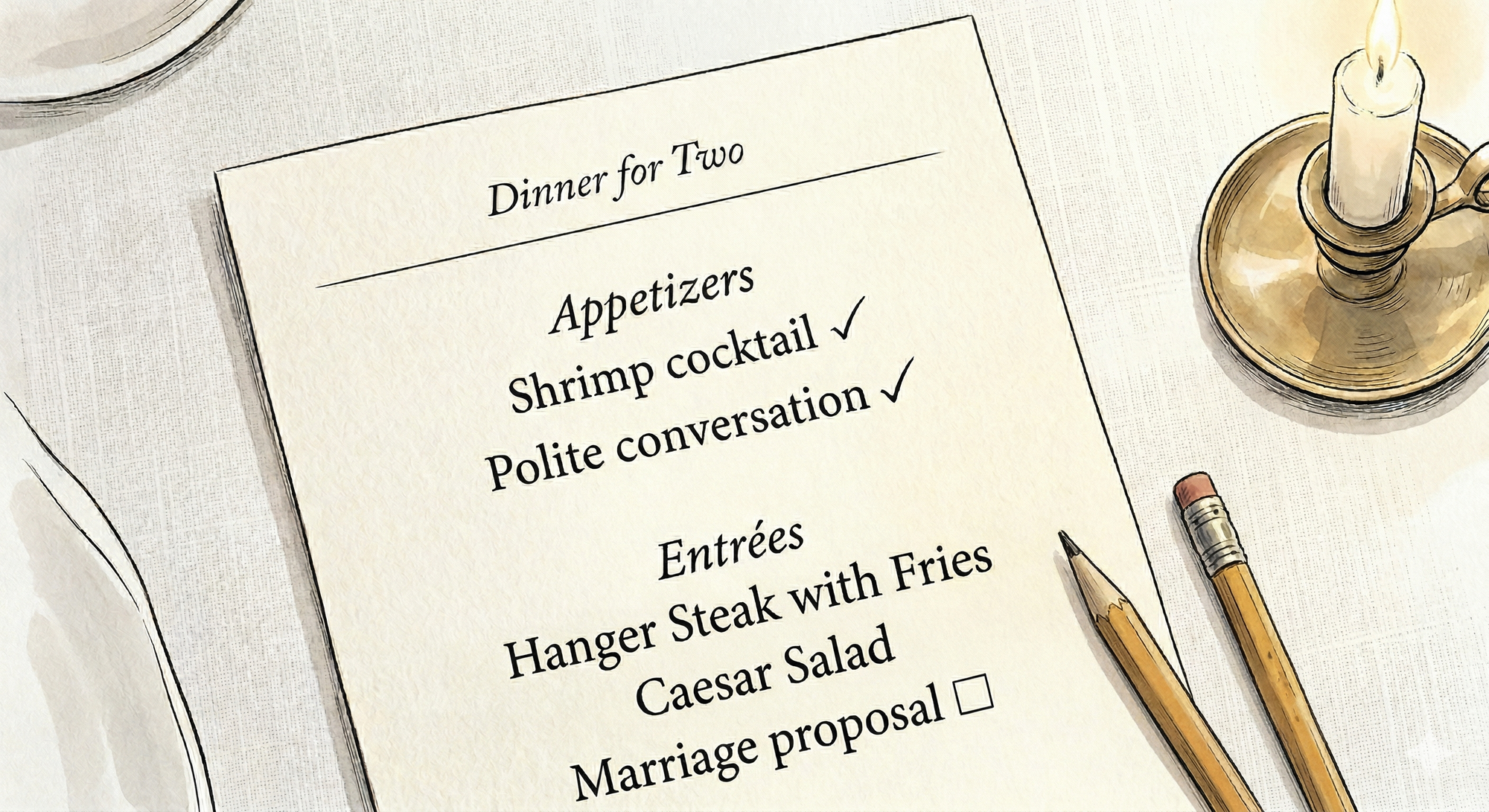
A woman I know recently went on a date with a man who, somewhere between the appetizers and the entrée, made her an offer.
"Look," he said, "at our age we'll keep our finances separate anyway. So if it doesn't work out, no big deal. Let's just get married."
She sat across from him trying to figure out what had just happened. He was, she told me later, a genuinely nice man. Devout. The kind of member who would never consider anything beyond a kiss before marriage. He meant it sincerely. That's almost the strangest part.
She told me the story the way you'd describe a fender-bender: a little stunned, a little annoyed, and mostly just confused about how she got there.
Around the same time, I was having a different but strangely parallel conversation with someone I'd been seeing. She told me that marriage is non-negotiable before any physical relationship. That she needs total commitment. And then, after some conversation about some of my concerns about marriage, especially one with short engagement: "I know you're scared of marriage, but we could sign a prenup. And if it doesn't work out, we can get divorced."
I've been sitting with both of those conversations ever since. Because on the surface they look completely different, one is a casual shrug toward commitment, the other is a deeply sincere expression of faith and values. But underneath, they're doing something surprisingly similar. Both are treating marriage as a mechanism. A door you walk through to get to the thing you actually want. And both, in their own way, are quietly hollowing out the very institution they claim to hold sacred.
I want to think through that honestly. Not to criticize anyone's faith or their choices. But because I've now heard versions of this enough times, from people I've dated, people they know, and the midlife singles forums that light up every week with some variation of "why won't anyone commit?", that I think it's worth asking some real questions.
The Covenant Is Ancient. The Paperwork Is Not.
Before we talk about what we're doing to marriage now, it helps to know what marriage actually has been throughout history, because it's more complicated than most of us were taught.
The covenant itself is genuinely old. The Jewish tradition of marriage predates Christianity by centuries, and it was never merely a legal transaction. It was a sacred threshold, a promise made before God and community that two people were choosing each other. That part is real, and I want to be clear that nothing I'm about to say is meant to diminish it.
But the institutional machinery layered around that covenant? That has a much messier history.
In ancient Rome, marriage was primarily a private contract between families: property, alliances, and legitimate heirs. No priest required. The Catholic Church didn't formally claim marriage as a sacrament until the 12th century, and didn't require a priest to officiate until the Council of Trent in 1563. Before that, for most of Christian history, mutual consent between two people was all that made a marriage valid. People married in fields and kitchens, wherever two people and some witnesses happened to be.
And when the Church did take over marriage, it wasn't purely out of spiritual concern. Academic research on medieval Church economics is pretty direct: the Church turned marriage into a significant revenue source. Fees for dispensations. Ecclesiastical courts that litigated marriage disputes for profit. The power to declare children illegitimate and claim estates. Estimates put annual Church revenue from marriage-related fees in England alone at nearly £32,000 per year in medieval currency. The Church owned the pathway to salvation, and marriage became a tollbooth.
The civil marriage license in the United States didn't become universal until 1929.
None of this diminishes the sacredness of the covenant. But it does suggest that when we treat every administrative layer around marriage as equally ancient and equally sacred, we may be confusing what is genuinely holy with what is historically convenient. The human need to mark commitment with ritual and witness is as old as human beings. Who must officiate, what paperwork must be filed, what box must be checked first: that part has always served someone else's interests at least as much as the couple's.
The Rules Made Sense, For Someone Else's Life
Here's what I want to say clearly, because I think it matters: the traditional standards around physical intimacy made genuine sense in their original context.
For young people building families, the case for strong guardrails is real. Unplanned pregnancy. Sexually transmitted infections. Emotional entanglement before the maturity to evaluate it clearly. The disruption to family formation when relationships break apart before they've been properly committed to. These are not invented problems. They are the lived experience of generations.
And in the LDS faith specifically, the standard is broader than most people outside the community understand. It isn't simply about sex. Any physical expression that might lead to arousal, anything beyond a kiss, has historically been considered a violation of the law of chastity, grounds for loss of temple privileges. That standard reflects a genuine, demanding theology about the body and covenant preparation. I'm not dismissing it.
But I am a man in his 50s writing about people in their 40s, 50s, and 60s. People with grown children. Grandparents, in most cases. This is a community where people tend to marry young and start families early. People who have already navigated family formation, and in many cases, watched it end. People who are, by any measure, the most experienced adults in the room when it comes to long-term relationships and sex, even if all of that experience happened within a single marriage.
The risks that justified the rules have fundamentally changed. The rules have not. They are applied with the same force to a 54-year-old grandmother as to a 19-year-old moving into a college dorm. And I think we need to be honest about what that costs, not just philosophically, but personally. Practically, not doctrinally.
I'll be honest about my own version of it. I have not been a saint since my marriage ended. I know what physical closeness feels like when it's real and mutual and freely chosen. I also know what it felt like to be in a marriage where that part of the relationship didn't exist, where two people shared a home and a life but were strangers to each other's bodies. That experience left marks. And when someone I care about suggests that the solution to our situation is to stop being physically close until after a wedding, something in me that is not theological but is very human says: I have been in that place before, and I am not going back.
I say that not to complain, and not to make a case for recklessness. I say it because I suspect I am not the only one who feels it. And because that feeling deserves to be part of this conversation.
What Actually Builds a Bond
Here is the part nobody in a Sunday School class is going to tell you.
A woman I know described it simply: as intimacy between two people grows, so does the desire to share it more fully. That's not a failure of willpower. That's not weakness. That's two people responding normally to what is happening between them.
Physical closeness is one of the primary pathways to lasting commitment. Not its reward, but its mechanism. The neurochemistry is not complicated: touch and intimacy trigger oxytocin, the same bonding hormone released during childbirth and breastfeeding. It shifts how two people perceive and feel toward each other over time. It is one of the most powerful pair-bonding processes human biology has ever produced.
And intimacy in this sense isn't only about sex. It's about the accumulation of closeness, warmth, physical presence, the gradual lowering of defenses that happens when two people allow themselves to be genuinely near each other. That process, allowed to unfold naturally, tends to build the very thing we say we want: two people who feel genuinely bonded, genuinely chosen, genuinely committed.
The research on what happens when that bonding process is absent from a marriage is not subtle. Studies suggest that approximately 74% of sexless marriages end in divorce. Couples who have sex less than once a week are up to 50% more likely to divorce than those who don't. This is not about frequency as a performance metric. It is about what sustained physical intimacy does to the emotional architecture of a relationship over time, and what its absence quietly undoes.
I can speak to this one from closer than I'd like. Years ago, I dated a woman seriously. We had long, honest conversations about whether we had a future together, and eventually concluded that our differences were too significant to bridge. We went our separate ways. About three and a half years later, we reconnected. In the time between, she had met a man, married him, and divorced him. He had checked every box the faith asks for. He never once crossed a physical line before the wedding. She took that as a sign of character, of genuine respect. What she discovered afterward was something different: he had never made room for her in his life at all. She couldn't change the decor. She had nowhere in his house to do her work. Her belongings went in the garage. She had a drawer in the bathroom. They never went to bed at the same time.
She hadn't found an uncommitted man. She had found a man who had performed commitment perfectly and had no idea how to actually practice it.
When we reconnected and she told me that story, I recognized it immediately. Not because I had predicted it, but because the pattern it described was the same one I had been trying to put into words. The conversation we were having about what intimacy and commitment actually require for people at our stage of life, that is the conversation this article is really about. And it is one more people in this community need to have openly.
We Are Making It Harder, Not Easier
The online forums for midlife LDS and faith-adjacent singles light up regularly with some version of the same complaint. Men won't commit. Nobody wants to get married anymore. The institution is devalued. Something has been lost.
That frustration is real, and I'm not dismissing it. But I think the people expressing it are often diagnosing the wrong problem.
Before I go further, I want to acknowledge something, because if I don't, someone will rightly point it out. The experience I've been describing, the man who is emotionally absent, physically withholding, and utterly disconnected, is one extreme. There is another one. Some women in this community have encountered men who treat physical intimacy as a transaction, who lose interest entirely if a relationship doesn't move quickly in that direction, who use the language of connection to pressure rather than build. That is real, it is its own kind of damage, and it is not what I'm advocating for. The answer to emotional unavailability is not aggressive pursuit. Both patterns, in their own way, are failures of genuine intimacy. I'm writing about the first one because it tends to go unnamed. But I see the second one too.
What I'm arguing for is something in the middle, something that looks less like a rulebook and more like two adults paying honest attention to each other.
The research on this population tells a consistent story. Midlife singles from purity culture backgrounds are already dealing with limited dating scripts, confusion about physical boundaries, deep shame around desire, and dating pools shaped by the same unresolved patterns. These are people who, in many cases, went from their parents' home to a marriage with almost no experience navigating adult intimacy. And now they're in their 50s, trying to form new bonds, and the cultural guidance they're receiving is to pull back further.
Consider what that actually looks like in practice. Two adults are spending real time together. The connection is genuine. The attraction is real. And then, because of sincere faith or social pressure or genuine belief, one or both of them decides they should stop being alone together late at night. Pull back from physical closeness. Remove the temptation.
The intention is honorable. But functionally, what that decision does is remove the conditions most likely to deepen the bond. For men, whose desire for closeness requires cultivation rather than suppression as they age, a relationship deliberately kept at arm's length doesn't build toward commitment. It slowly loses gravity. For women whose lives are genuinely full, with grandchildren, friendships, independence, and a life they've built and are proud of, the case for disrupting all of that has to be compelling. A relationship kept carefully contained by rule doesn't tend to make a compelling case.
We are asking people to sign a lifetime contract based on a preview with key features disabled. And then expressing surprise that fewer people are signing.
When Marriage Becomes a Checkbox
Which brings me back to where I started.
When marriage becomes the mechanism by which two adults are permitted to finally express what they already feel, when it is the box that must be checked before the relationship is allowed to be fully itself, something gets inverted. The commitment is supposed to come first, and the marriage is supposed to name and honor it. But what happens when marriage comes first, and commitment is assumed to follow?
Sometimes it does. Plenty of people have built genuine, lasting marriages from exactly this starting point, and I'm not suggesting otherwise.
But I have now heard, more than once, from people I've dated and people they know, a version of this: "Let's just get married. We can always get divorced if it doesn't work out." Said not callously, but practically. Even hopefully. As though the ceremony were a trial run rather than a threshold.
The irony is that this framing, the casual prenup, the graceful exit plan, the marriage as low-stakes administrative step, is precisely what the people who complain about marriage being devalued say they're worried about. And they're not wrong. But the devaluing is happening from both directions. The casual "no big deal if it doesn't work out" approach cheapens it from one side. The "let's rush to the altar so we can finally be together" approach cheapens it from the other. Both are using marriage as a means to an end. Neither is treating it as the serious and beautiful thing it's supposed to be.
The devout man who made his date a marriage proposal between appetizers wasn't a bad person. He was, by every account, a genuinely good one. But somewhere along the way, the sequence of his faith, marry first and bond later, had become more important than the substance of what marriage is actually for.
What We're Really Asking
I'm not arguing against marriage. I'm not arguing against faith, or standards, or the genuine sacredness of two people committing their lives to each other.
I'm asking whether we've thought clearly about what we're actually doing when the commitment comes after the ceremony rather than before it. And whether the rules designed to protect something sacred might, in some cases, be producing the hollow version of the thing they were meant to protect.
What would it look like to build the conditions for real commitment rather than rushing toward the ceremony that permits it? To let two adults, experienced, clear-eyed, and long past the season of family formation, develop the closeness and bonding and genuine knowing of each other that real commitment is actually built on?
The covenant between two people who have genuinely chosen each other, who have taken the time to actually know each other and allowed the bond to form the way bonds form, that is a serious and beautiful thing.
What it does not deserve is to be used as a checkpoint. A permission slip. A technicality that unlocks the relationship that was already real.
And the people who love and honor the institution of marriage most should probably be the first ones willing to say that.