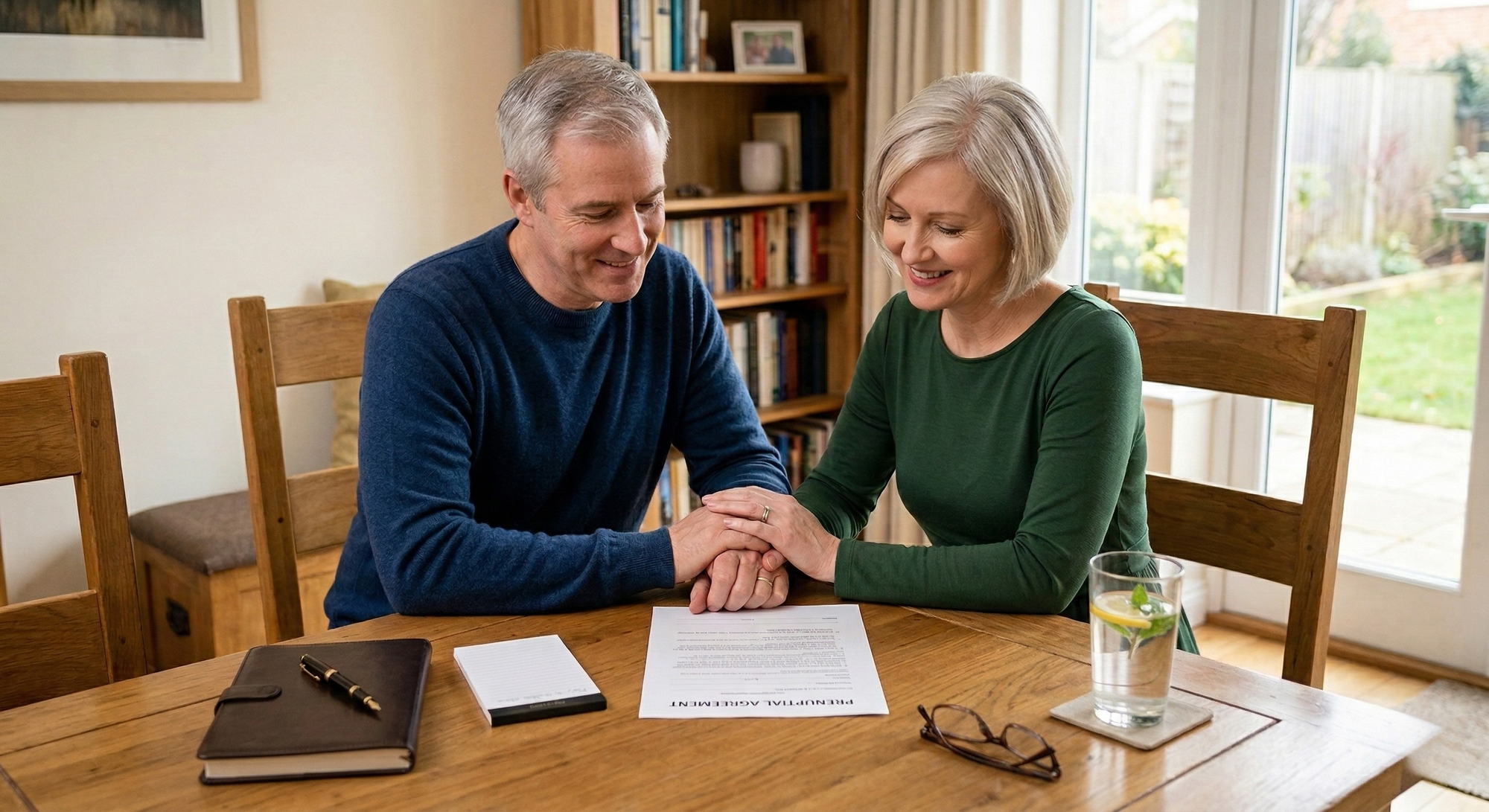
If you’re a divorced midlife single, you already know something your younger self didn’t: love can be real… and life can still change.
That’s why we’re going to say the quiet part out loud:
A prenup isn’t planning for divorce. It’s planning to be clear, kind, and protected—especially when you’ve already been through the confusing version once.
First: the spicy truth—everyone already has a prenup
In a recent podcast, divorce attorney James Sexton makes a point that surprises people: every marriage already has a “prenup.” If you don’t write your own, your state’s default divorce laws become the rulebook for what happens if the marriage ends. In other words, “no prenup” doesn’t mean “no rules.” It means “rules you didn’t choose.”
Why prenups can be especially good after divorce
1) They reduce “fear dating”
Post-divorce, a lot of people aren’t afraid of love—they’re afraid of losing themselves, getting blindsided financially, or repeating the same painful patterns. A well-done prenup lowers the background anxiety and helps you date with clearer eyes.
Think of it as a seatbelt: not a prediction of a crash—just wisdom.
2) They force the conversations you wish you’d had the first time
Sexton also says something that applies to way more than law: the worst time to learn how to fight is in the middle of a fight. The same is true for money expectations, debt, kids, career tradeoffs, and family obligations.
A prenup process (done respectfully) makes couples talk about:
- what’s “mine, yours, ours”
- spending styles and debt
- whether one person might step back from work
- support expectations if illness or hardship happens
- protecting kids and inheritance in a second marriage
3) They protect love from resentment
Resentment often grows in the foggy areas: “I thought you meant…” “I assumed we agreed…” Clear agreements prevent quiet scorekeeping. That doesn’t make a relationship cold—it makes it sustainable.
4) They’re common in second marriages for a reason
Midlife relationships often come with real complexity: kids, co-parenting schedules, retirement accounts, homes, businesses, and sometimes an ex who will always be part of the picture. A prenup can help keep a new relationship from being swallowed by old baggage.
Do prenups lower divorce rates?
Here’s the honest version: it’s hard to prove a simple “prenup vs. no prenup” divorce rate, because couples who choose prenups may already be different (older, second marriages, more assets, more intentional).
However, there is research showing that when prenups became more enforceable in many states, divorce rates fell. A 2016 paper in The Journal of Legal Studies examined adoption of the Uniform Premarital Agreement Act (UPAA) and reports that making prenups reliably enforceable reduced divorce rates in America.
The practical takeaway: even if a prenup isn’t a magic “divorce preventer,” the process often helps couples get aligned, surface incompatibilities earlier, and reduce future conflict.
How to bring it up without killing the mood
Try this:
“I’m not bringing this up because I expect failure.
I’m bringing it up because I want us to be thoughtful and fair—no surprises.
I want both of us to feel safe.”
Final note
This isn’t legal advice—prenups vary by state, and they can be invalid if done poorly. But as a relationship move for divorced midlife singles, a prenup can be one of the healthiest signals of all: clarity, maturity, and care.