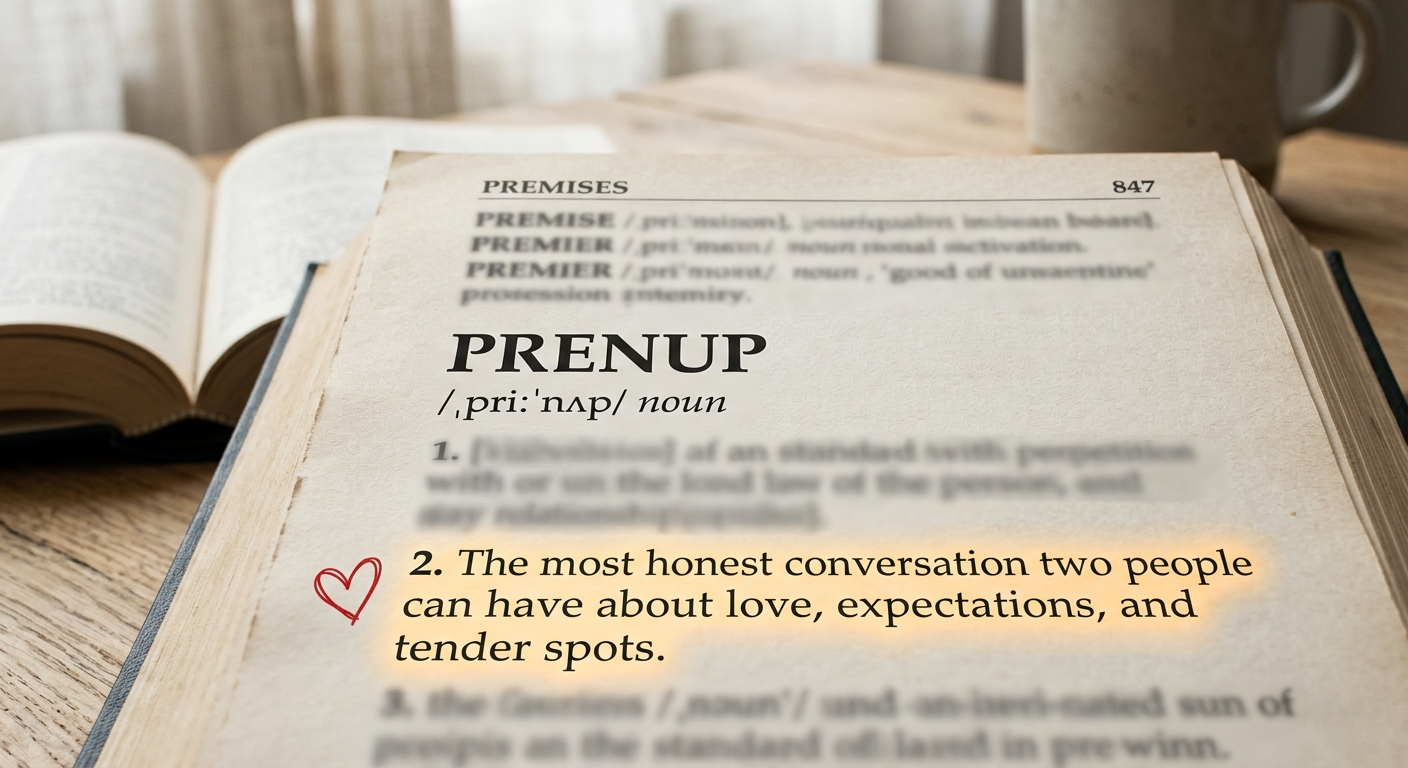
How a Facebook Comment War About Prenups Led to the Best Conversation I've Ever Had About Love
Stay with me.
Claire* (*not her real name) and I had ended things — or tried to. The kind of ending that doesn't quite end, where you've agreed that moving forward is too hard but you're still sending each other tender messages at odd hours, still sharing the small observations you'd normally only tell the person you're with. Technically separated. Emotionally still very much in each other's orbit.
The reason we'd stopped wasn't anger or judgment. It was something quieter and harder than that. We had discovered that we were in different places on some of the most personal questions two people can face — about intimacy, about faith, about what those things mean in a real relationship, not in theory. There was no villain in it. We weren't arguing. We were two people who respected and cared for each other deeply, trying honestly to figure out whether our differences on those questions were ones we could actually live with. We'd concluded, reluctantly, that maybe they weren't.
But reluctantly is the right word. There was too much that was genuinely good between us to make a clean break feel anything other than a loss. So we stayed in each other's orbit — carefully, tenderly — and we kept talking. Thinking out loud together about whether there were a few honest guardrails we could put in place that might let us navigate our differences without either of us having to abandon what we believed.
We were already deep in that conversation when my own comment section handed me the answer.
An article I had written about intimacy and commitment in midlife had generated 54 comments and a fair amount of heat. Some readers thought I was arguing for sex before marriage. Others were tangled up in a side argument about prenups — several women pushing back hard, saying prenups were just a way for men to protect their assets while keeping one foot out the door. A legal loophole dressed up as commitment.
I watched that argument for a minute. And then one commenter — a man named Alan — said something that stopped me.
"There's already a prenup in every marriage. It's called the laws of whatever state you got divorced in. You either write your own terms or you accept the government's defaults."
And something clicked.
Not about assets. Not about divorce law. About what a prenup actually requires two people to do before they can write one — and what that process might look like for two people who weren't even married yet, but were trying to figure out if they could be.
What the Research Actually Showed
I had come across a divorce attorney named James Sexton a while back — the kind of person whose job gives him an unusually clear view of what goes wrong in marriages, and why. He had said something I hadn't been able to shake: "People who get prenups usually don't get divorced."
Not because of the legal protection. Not because wealthy people have less financial stress. When researchers looked at why prenup couples had better outcomes, the answer was something else entirely.
It was the conversations.
Before you can write a prenup, someone has to ask: What do you actually expect? What matters to you? What are your hard stops? What does "sharing a life" mean to you, in practical terms? And the other person has to answer. Out loud. Honestly. To someone who is paying attention.
Most couples never have those conversations. They inherit a picture of the destination — in our world, a very specific and beautiful one — and they trust that love and faithfulness will fill in everything between here and there. Sometimes it does. More often, the blanks fill quietly with assumptions. And assumptions, unexamined, become resentments.
Prenup couples weren't staying together because of a legal document. They were staying together because they'd told each other the truth before committing — and discovered the truth was something they could actually build on.
And here was the thing I kept turning over: this didn't only apply to people getting married. It applied to anyone serious about building something with someone. The clarity it forced — about desires, expectations, the wounds from past relationships, the things you'd never accept again — that was valuable at every stage. For two people in their 40s or 50s trying to figure out if their differences were navigable. For anyone stepping into exclusivity and saying, for the first time, it's just us now.
I sent Claire a message.
The Conversation
What you just watched is not a demonstration or a template. That's a real conversation, lightly trimmed for length, between two people who were figuring out whether they wanted to try again — and discovering, in the act of figuring it out, that they already knew the answer.
I want you to notice something about the tone of it. Nobody was performing. Nobody was trying to say the thing that would land well. There was no strategy. Just two people naming what they actually wanted, what they couldn't accept, and where their tender spots were — and being met with warmth on the other side.
That's what honesty does when it lands in the right place.
Claire's request — if another woman approaches you when I'm nearby, could you reach for my hand so I don't feel invisible? — isn't a rule. It's a wound, held carefully and offered as information to someone she trusted with it. In a relationship that was trying to find its footing again, that kind of transparency wasn't risky. It was generous.
The scratch ticket exchange — her asking whether I gamble, me asking whether an occasional one with my daughter counts — is in there for a reason too. That moment of humor, that small negotiation about a grey area, is exactly what this process looks like when it's working. Not a tribunal. A conversation between two people who are trying to understand each other.
What the Thread Was Really About
I went back to those 54 comments after our conversation and read them differently.
The fight about prenups wasn't about prenups. It was about the fear that saying what you actually want — explicitly, to someone you love — will scare them away. That your needs are too much. That a person who really loved you should just know. That bringing a list of expectations to a relationship means you don't fully trust it.
One commenter had put it almost exactly right: "LDS dating scripts are extremely limited. People treat marriage like a checkbox on the to-do list on their way to the real goal."
That's the whole thing. When the script tells you what the destination looks like but doesn't give you tools for the journey, you navigate by guessing, by performing, by hoping love will somehow fill in all the blanks you're both too afraid to name. It doesn't. It never does. And the resentment that grows in those blanks is what fills comment sections at midnight, 54 people deep, arguing about legal documents when what they're really asking is: is it safe to say what I want?
It is. But someone has to go first.
What Goes In One of These Things
The conversation with Claire sketched the structure out naturally. Here's what a pre-relationship agreement actually needs to cover.
Hopes and Desires. The tender, romantic wants you've been embarrassed to say out loud. I want someone to hold hands with on walks. I want regular date nights. I want someone who introduces me with pride. I want someone to pray with twice a day. These aren't demands — they're invitations. Saying them out loud is an act of trust, and how your partner responds tells you something real about who they are.
Expectations. The practical architecture of a shared life. Who plans dinner. How you handle finances. What communication looks like when one of you goes quiet. These expectations exist in every relationship whether you name them or not. The only question is whether they become a conversation or a slow accumulation of unspoken resentment.
Non-Negotiables. The hard stops. The things that aren't preferences or requests, but genuine dealbreakers — places where you know already that repeated violation means the relationship cannot continue. These should be few. They should be honest. They deserve to be said without apology.
Tender Spots. The section most people wouldn't think to include, and arguably the most important. Every person who has been through a difficult relationship carries specific, identifiable wounds. The particular flavor of invisible they've been made to feel. The exact kind of dismissal that lands like a door closing. A loving partner cannot navigate around wounds they don't know exist — and a partner who responds to this section with impatience or defensiveness is telling you something important about what kind of safety you'll find with them.
Shared Values and Grey Areas. Faith practices. Media standards. How you handle friendships with the opposite sex. Health and lifestyle. The places where two people's defaults are genuinely different — similar enough to negotiate, different enough to matter. Not everything needs a rule, but the places where your instincts diverge deserve a real conversation, not a silent collision down the road.
Why This Matters Especially for Us
Most of the people reading this grew up with a very detailed script about what commitment was supposed to look like. The script was specific and beautiful and held up everywhere we looked. The journey was left almost entirely to guesswork.
We were handed a picture of where we were supposed to end up. Nobody gave us a language for getting there.
What those 54 comments were really showing me was that almost nobody in our world had been taught that it was safe — or even good — to say out loud what they wanted from a relationship. We'd been taught what to want. We'd been handed a destination and told that faithfulness would get us there. The language of honest, explicit, adult desire — of naming what you need and what you won't accept, plainly, without shame — that language is new for most of us.
It's worth learning.
The research on prenups says that clarity before commitment changes outcomes dramatically. That is not a coincidence. That is just what honesty does.
You don't need a lawyer. You don't need a formal contract. You need a conversation, and the willingness to tell the truth about what matters to you.
Claire said it somewhere in the middle of ours, and I keep coming back to it.
I think that clarity is so awesome.
It is.
And for what it's worth: we're giving it another try. Not because the hard questions went away — they didn't — but because two people who are willing to tell each other the truth, carefully and with warmth, are better equipped to navigate their differences than two people who are hoping the other one will somehow just figure it out.
The conversation wasn't just a method for building a better relationship.
It was the relationship beginning.
Try It
If you're approaching exclusivity with someone — if you're about to step off the apps and say it's just the two of us now — try this.
Not because love needs paperwork. But because the version of you who says what you actually want, and genuinely hears what your partner needs, is so much better positioned to build something real than the version who hopes it will all just work itself out.
The template is waiting. It's not legal. It's not binding. It's just a place to start telling the truth.
DOWNLOAD THE FREE PDF TEMPLATE HERE
Chris Roberts is a founding mentor at Unchaperoned Life — a community for midlife singles who are done performing and ready to actually connect. With themselves first, and then with someone worth showing up for.