Worthiness Culture Series: Unchaperoned Life | Post 1 of 6
There is a story the church tells about people who leave. It is not usually told out loud, from the pulpit. It lives instead in the spaces between conversations — in the way a ward member's name stops coming up after they stop showing up, in the careful language used when someone's adult child "fell away," in the quiet consensus that forms around people who could not keep up with the demands.
The story goes like this: they wanted an easier life. They wanted to sin without consequence. They found a reason — church history, a social issue, a difficult bishop — and they hung their coat on that nail and walked out. It was, ultimately, a choice about desire. They wanted the world more than they wanted God.
That story is almost entirely wrong.
Jeff Strong spent three years conducting what he believes is the largest disaffiliation study ever done in the LDS community. Fifteen thousand participants. Hundreds of hours of interviews. The result was a book and a body of data that should permanently retire the "permission to sin" narrative — if people are willing to look at what the numbers actually say.
The headline finding is not the one that gets quoted in Sunday School. It is this: 85% of people who stepped away from the LDS church spent more than 100 hours over multiple years trying to work through their questions and stay. Nearly half — 49% — spent what Strong describes as "limitless hours" over at least five years before they finally left.
These were not people looking for a way out. They were people doing everything they could to stay in.
The Narrative That Made Us Smaller
Before we get to the data, let us be honest about what the wrong narrative cost.
If you grew up in the church, you probably absorbed some version of this story about people who leave. Maybe you told it yourself, with the best intentions. Maybe it was told about you — by parents, by ward members, by a bishop who framed your questions as evidence of spiritual weakness rather than genuine searching.
And if you are reading this in midlife, there is a good chance you have lived inside the consequences of that narrative. Either you stayed — performing certainty you did not always feel, managing the parts of yourself that did not fit — or you left, and discovered that leaving came with a social cost nobody warned you about. Lost friendships. Changed family dynamics. The particular loneliness of being the person who stopped fitting the story everyone else was still living.
What Strong's data does is something simple and radical: it insists that you were not the problem. The story was.
What the Numbers Actually Show
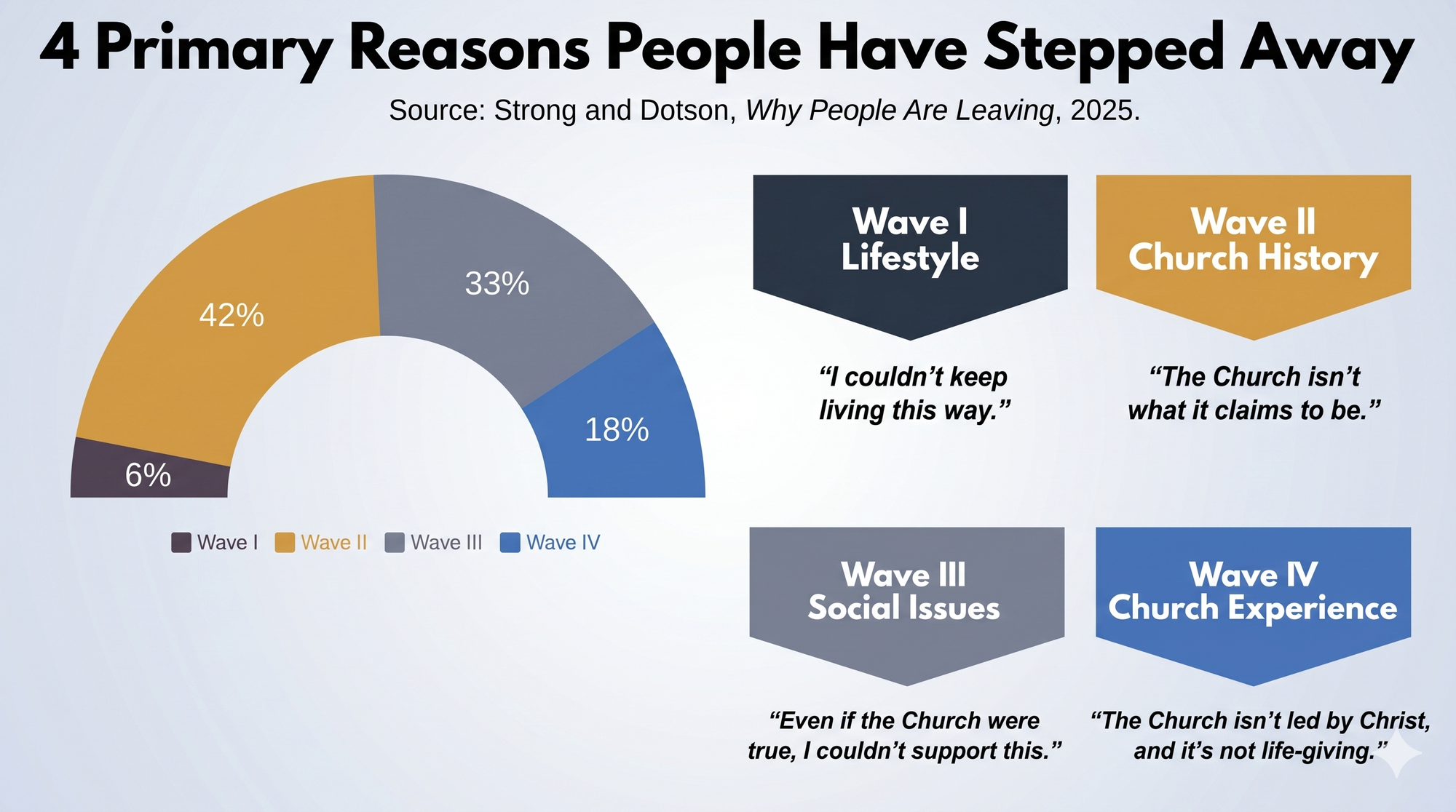
Strong identified four primary reasons people step away. He calls them waves, and they account for the full picture in ways that the popular narrative never did.
Wave I — Lifestyle (6%). This is the smallest bucket, and it is the one the cultural narrative treats as the largest. These are people for whom the expectations and responsibilities were genuinely depleting — the guilt, the hollowing out, the sense that the demands were not sustainable. Six percent. Not the majority. Not even close.
Wave II — Church History (42%). The largest single wave. Concerns about Joseph Smith, polygamy, the translation of the Book of Mormon, inconsistencies in the church's historical narrative. These are people who did not discover church history on a hostile website — they went looking for answers with genuine faith and found things they could not reconcile. They spent years trying to reconcile them anyway.
Wave III — Social Issues (33%). Sexual identity, gender equality, financial transparency. People who found themselves unable to support institutional positions that conflicted with their deepest moral convictions. Note that this group is not indifferent to faith. Many of them are people whose faith is precisely what made certain positions feel wrong.
Wave IV — Church Experience (18%). Strong considers this the most interesting wave, and possibly the most undercounted. These are people who did not leave because of history or social issues. They left because the church stopped feeling like Christ. Too much institution, not enough carpenter of Bethlehem. Too much obedience, not enough transformation. They wanted the living water. They kept getting handed a handbook.
Strong is explicit that Wave IV functions differently from the others. It does not just cause departures on its own — it amplifies every other reason for leaving. When your church experience is genuinely nourishing, you can hold difficult questions about history or social policy and stay. When it is not, even small doubts become exits.
That is the key insight. The four waves are not independent variables. The cultural soil determines whether people can survive the storms.
The Soil Underneath Everything
Strong uses a metaphor that is worth sitting with. He traces the word "culture" back to its Latin root: colere, meaning to cultivate. To tend. To make something able to grow.
His argument is that the LDS cultural soil has developed a serious imbalance. It is very good at protection and stability — holding the plant in place when storms come. It is considerably less good at nourishment. And a plant that is held in place but not fed does not survive the storms it was supposedly protected from. It just dies more slowly, and in a more respectable posture.
The four tensions Strong identifies in that soil are worth naming precisely, because they map almost exactly onto the experiences of midlife singles navigating relationships after a faith transition — or navigating faith after a relationship transition.
Standards versus Acceptance. The church's standards are real and, Strong would argue, not the problem. The problem is when standards function as sorting mechanisms rather than growth tools. When someone who believes differently, or struggles with a particular commandment, receives signals from their community that they do not fully belong — that their way of experiencing faith is not acceptable — the soil becomes hard and unyielding. Plants cannot root in concrete.
Strong's line on this is the one I keep coming back to: Standards exist to elevate people, not sort them. If you have spent time in midlife singles culture — in wards, on apps, in any of the spaces where faith-background singles try to find each other — you have felt that distinction collapse in real time.
Sanctuary versus Growth. The church as refuge is a genuine good. The church as the only posture produces people who have never been tested, who built their faith on traditions rather than roots, and who collapse when the storms arrive. Strong quotes it directly: a ship is safe in the harbor, but that is not what ships are for. The temple-recommend holder who has never genuinely wrestled with doubt is not spiritually strong. They are spiritually untested. The difference matters enormously when life gets hard.
Agency versus Fealty. Strong uses the word "fealty" — unconditional obedience with no agency — to describe the extreme end of an otherwise reasonable principle. The collision between institutional authority and personal conscience is where a lot of midlife singles quietly live. Not openly in rebellion. Just quietly out of alignment, performing the expected answers while privately living something more complicated.
Harmony versus Conformity. Strong's image here is the orchestra: harmony is many instruments playing together; conformity is everyone playing a kazoo. The pressure to express faith in exactly one acceptable way — the testimony that follows a predictable script, the conversion narrative that hits the required beats — does not produce a stronger community. It produces pretense. And pretense, as Strong notes, is genuinely exhausting.
Why This Matters for the Rest of Us
Here is the thing about Jeff Strong's data that keeps me up at night.
He is talking about people who left the church. But he is describing the experience of almost every midlife single I know who stayed.
The 49% who spent limitless hours over five years trying to hold things together — that is not just the faith transition story. That is the marriage story. That is the story of someone who spent years in a relationship that was not working, trying harder, praying harder, doing everything the framework said to do, while the gap between what they believed love was supposed to feel like and what they were actually experiencing kept quietly growing.
The Wave IV experience — the church stopped feeling like Christ, too much institution and not enough living water — is the experience of sitting in sacrament meeting as a divorced single adult and feeling like you are the only person in the room who does not fit the family unit on the program cover.
The collision between fealty and conscience — performing the expected answers while living something more complicated — is the experience of every person who has ever sat in a bishop's interview and given a technically accurate answer that was not the whole truth, because the whole truth would have cost too much.
Strong's research is not just an explanation for why people leave. It is a diagnosis of a cultural operating system that does real damage to real people — including the ones who never leave at all.
What the 94% Are Actually Telling Us
When Strong's team ran the numbers, they found that only about 6% of people who stepped away did so primarily because they wanted a lifestyle the church would not permit. The other 94% were trying, in their own way, to stay. They were searching. They were wrestling. They were spending years of their lives trying to reconcile the faith they loved with the questions they could not quiet.
Read that one more time. Ninety-four percent.
The story that they wanted out — that they found a convenient excuse, that they were looking for permission to sin — is not supported by the data. It is a defensive narrative that the community built to protect itself from a harder question: what if we contributed to this?
Strong is careful here, and so will I be. He is not blaming church leaders. He is not saying the doctrine is wrong. He is saying that the cultural soil — the way the doctrine gets lived and applied and enforced at the ward level, in families, in bishops' interviews, in the quiet consensus of who belongs and who does not — has produced conditions that push people out even when the people themselves desperately want to stay.
That is not a reason to abandon faith. It is a reason to look clearly at what the culture has done with it.
The Midlife Divorce Parallel
I want to make one connection explicit, because it is the one most relevant to this community.
The data on faith transitions almost perfectly mirrors the data on long-term marriages in high-commitment religious cultures.
People do not leave because they stopped caring. They leave because they cared enormously, tried exhaustively, and eventually ran out of a particular kind of energy.
The energy required to keep performing certainty you do not feel. The energy required to keep absorbing signals that you are slightly not enough. The energy required to stay inside a framework that was designed for someone slightly different from who you actually are.
Strong found that when faith-transition conversations go poorly — when a devout parent or a church leader responds to honest questions with fear, defensiveness, or correction — the person asking is significantly more likely to leave. Not because the response changed what they believed. But because it told them, one more time, that this was not a safe place to be honest.
That is the core damage. Not the doctrine. Not the history. The accumulated experience of not being safe to tell the truth.
Every midlife single who has ever sat across from someone they were beginning to love and felt the familiar pull to manage the presentation — to give the acceptable version of their story rather than the real one — knows exactly what that damage feels like from the inside.
What Comes Next
This series is not about leaving the church. It is not about staying either. It is about something more specific: the cultural operating system that worthiness culture installs in people who grew up inside it, and what that system does to the capacity for genuine connection — with God, with a partner, with yourself.
The 94% statistic matters because it is the most direct refutation of the shame the culture produces in people who struggle or leave. You were not weak. You were not faithless. You were not looking for a way out. You were trying, in the way that 94% of people try: with everything you had, for longer than anyone should have to.
The question this series is going to sit with is not whether the doctrine is true. It is whether the culture built around the doctrine has helped or hurt the people it was supposed to serve.
Strong's data suggests the answer is: both. And the part that hurt deserves to be named — not to shame the institution, but to extend some grace to the people still carrying the weight of it.
You are not the mote. You are not Laman and Lemuel. You were trying, sincerely, with the tools you were given.
That is the beginning of something worth building on.
Unchaperoned Life exists for people who are done performing worthiness — and ready to find out what connection looks like when it is built on something real.
Coming Up Next: "The Covert Contract Nobody Signed — How Nice Guy Culture and Worthiness Culture Became the Same Problem"