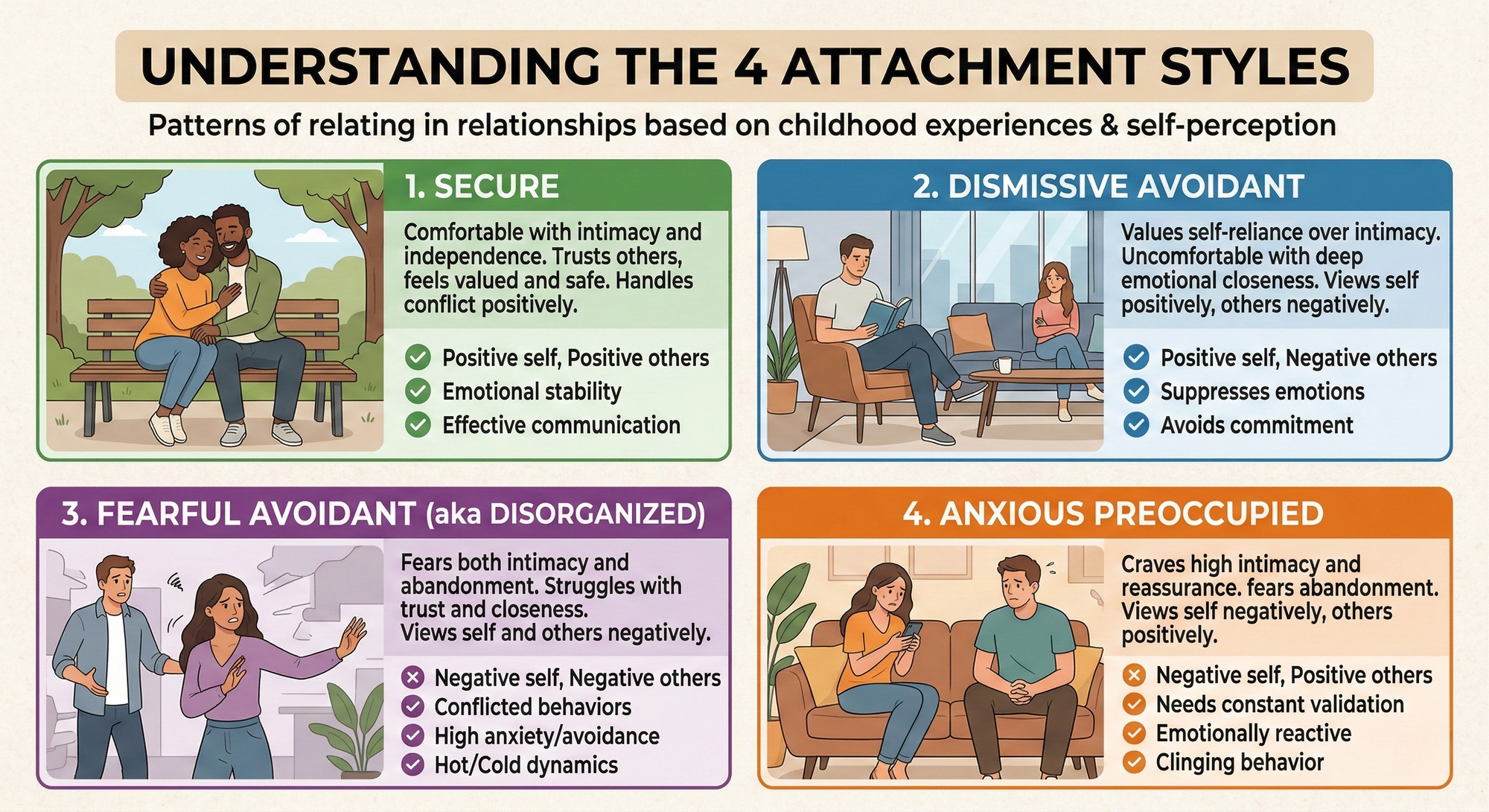
Navigating the dating scene after a significant life change like divorce or as a midlife single can be a complex emotional journey. Understanding attachment styles, as outlined in the book 'Attached' by Amir Levine and Rachel S.F. Heller, can provide invaluable insight into your own patterns and those of potential partners. This guide explores the four main attachment styles and how they manifest in individuals re-entering the dating world, offering strategies for healing, boundary setting, and recognizing when a relationship may not be viable.
The Four Attachment Styles
Attachment theory suggests that our early relationships with primary caregivers shape our internal working models of relationships, influencing how we connect with others throughout our lives.
1. Secure Attachment
Signs:
- Self-sufficient and comfortable with intimacy: Secure individuals can be both independent and deeply connected in relationships.
- Trusting and optimistic about relationships: They believe in the possibility of healthy, lasting connections.
- Effective communicators: They can express their needs and feelings clearly and respectfully.
- Resilient in the face of conflict: They view disagreements as opportunities for growth rather than threats to the relationship.
- Seek and offer support: They are comfortable asking for help and providing it to their partners.
Impact on Dating: Securely attached individuals tend to form stable, satisfying relationships. They are less likely to engage in drama or push-pull dynamics. They approach dating with a balanced perspective, open to connection but not desperate for it.
2. Dismissive-Avoidant Attachment
Signs:
- Value independence and self-reliance highly: They often prioritize personal space and autonomy.
- Tend to suppress emotions and avoid emotional closeness: They may appear detached or uninterested in deep emotional sharing.
- Discomfort with vulnerability: They may deflect personal questions or shut down when conversations become too intimate.
- May idealize independence and view dependence as weakness: They might express a preference for being alone or having minimal emotional entanglement.
- Can be perceived as aloof or uncaring: Their outward demeanor might not reflect their inner feelings. They are sometimes misclassified as narcissists.
Impact on Dating: Dismissive-avoidant individuals may struggle with commitment and intimacy. They might initiate relationships but then pull away when things become too serious or emotionally demanding. They may seek partners who are also independent or who can tolerate their emotional distance.
3. Fearful-Avoidant Attachment (aka Disorganized)
Signs:
- Desire for closeness but fear it simultaneously: They often crave connection but are terrified of being hurt or rejected.
- Inconsistent behavior: They may swing between seeking intimacy and pushing people away.
- Difficulty trusting others: Past negative experiences can lead to suspicion and a belief that people will eventually disappoint them.
- May have a history of trauma or unstable relationships: Their attachment patterns are often rooted in chaotic or frightening early experiences.
- Can be unpredictable and emotionally volatile: Their internal conflict can manifest as erratic behavior.
Impact on Dating: Fearful-avoidant individuals often create a "push-pull" dynamic in relationships. They might pursue a partner intensely, only to sabotage the connection when it starts to feel too real or safe. They can be challenging to understand and can lead to confusion and frustration for their partners.
4. Anxious-Preoccupied Attachment
Signs:
- Craving for closeness and intimacy: They often seek constant reassurance and validation from their partners.
- Fear of abandonment: They worry about their partner's feelings and commitment, often interpreting minor issues as signs of rejection.
- Tendency to be "clingy" or demanding: Their need for reassurance can manifest as excessive contact or emotional demands.
- Can be highly sensitive to perceived slights: They may overthink interactions and become anxious about the relationship's status.
- Often have a strong desire to merge with their partner: They may struggle with maintaining their own identity within a relationship.
Impact on Dating: Anxious-preoccupied individuals can be intense and demanding in their pursuit of connection. They may experience significant anxiety and distress if they don't receive the constant reassurance they need. This can sometimes lead to relationship instability if their needs are not met or if their partner feels overwhelmed.
Manifestations in Newly Divorced or Midlife Singles
Re-entering the dating world after a long-term relationship or divorce can amplify existing attachment patterns or bring them to the forefront.
- Newly Divorced: Individuals may be grappling with feelings of rejection, loss of identity, and a renewed desire for connection. Anxious-preoccupied individuals might be eager to find a new partner quickly to fill the void. Dismissive-avoidant individuals might retreat further into independence, while fearful-avoidant individuals may struggle with trust and intimacy due to the perceived failure of their previous relationship.
- Midlife Singles: This group may have established patterns over decades. They might be more aware of their needs but also more set in their ways. Secure individuals will likely approach dating with maturity. Avoidant individuals might be less inclined to seek deep connection, while anxious individuals may be more determined to find "the one" to avoid loneliness.
Strategies for Helping Partners with Insecure Attachment Styles Heal (If Willing)
Healing insecure attachment is a journey that requires self-awareness and a willingness to change. If you are in a relationship with someone who has an insecure attachment style and they are open to growth, here are some strategies:
- For Anxious-Preoccupied Partners:
- Provide consistent reassurance: Offer verbal affirmations and demonstrate your commitment.
- Be predictable and reliable: Follow through on your promises and maintain open communication.
- Encourage independence: Gently support their individual pursuits and interests outside the relationship.
- Help them identify and challenge anxious thoughts: Encourage them to question their fears and seek evidence for their worries.
- For Dismissive-Avoidant Partners:
- Respect their need for space: Don't push for constant intimacy or emotional sharing.
- Communicate your needs clearly and calmly: Avoid accusatory language. They are very sensitive to criticism.
- Focus on shared activities and experiences: Build connection through doing things together.
- Be patient and persistent (but not pushy): Show them that you are a safe and reliable presence.
- For Fearful-Avoidant Partners:
- Be a stable and trustworthy presence: Consistency is key.
- Validate their feelings without judgment: Acknowledge their fear and confusion. Feeling understood is one of their biggest needs.
- Create a safe space for vulnerability: Let them know it's okay to be imperfect.
- Encourage professional help: Therapy can be particularly beneficial for this style.
Crucially, these strategies are only effective if the partner is willing to engage in the process. You cannot force someone to heal.
Setting Boundaries and Recognizing Unsalvageable Relationships
Setting healthy boundaries is essential for any relationship, especially when dealing with insecure attachment styles.
When to Set Boundaries:
- When your needs are consistently unmet.
- When your partner's behavior is causing you significant distress or anxiety.
- When you feel your own well-being is being compromised.
- When your partner is unwilling to acknowledge or work on their attachment patterns.
Examples of Boundaries:
- "I need to have some alone time each evening." (For avoidant partners)
- "I can't respond to texts immediately when I'm at work, but I will get back to you." (For anxious partners)
- "I need us to communicate respectfully, even when we disagree." (For all styles)
Recognizing When a Relationship is Unsalvageable: A relationship may be unsalvageable due to unaddressed insecure attachment when:
- There is a persistent lack of reciprocity: One partner consistently gives more than they receive, or their needs are always prioritized.
- Communication breaks down completely: Attempts to discuss issues are met with defensiveness, withdrawal, or anger.
- There is a constant cycle of conflict and brief reconciliation: The same issues resurface repeatedly without resolution.
- One or both partners are consistently unhappy and anxious: The relationship is a source of chronic stress rather than joy and support.
- There is a refusal to acknowledge or address the attachment patterns: If one partner is unwilling to explore their own role in the relationship dynamics, progress is unlikely.
- Your own well-being is severely impacted: You are experiencing significant emotional distress, anxiety, or depression due to the relationship.
Understanding attachment styles is a powerful tool for navigating the complexities of dating and relationships. By recognizing these patterns in yourself and others, you can foster healthier connections, set appropriate boundaries, and make informed decisions about your romantic future. Remember, self-awareness and a willingness to grow are the cornerstones of secure attachment.