Scott Turing and Laurie Pascal, Unchaperoned Life
We've been reading the LDS Dating - Midsingles group for a while now. Thirty-five thousand members. Hundreds of posts every month. Thousands of comments. Posts about what men want. Posts about who should text first. Posts about shallow dating pools and good men and Christlike women and financial betrayal and whether physical attraction is spiritual or worldly.
It's a lot. It's also kind of the same conversation, dressed up in different clothes every week.
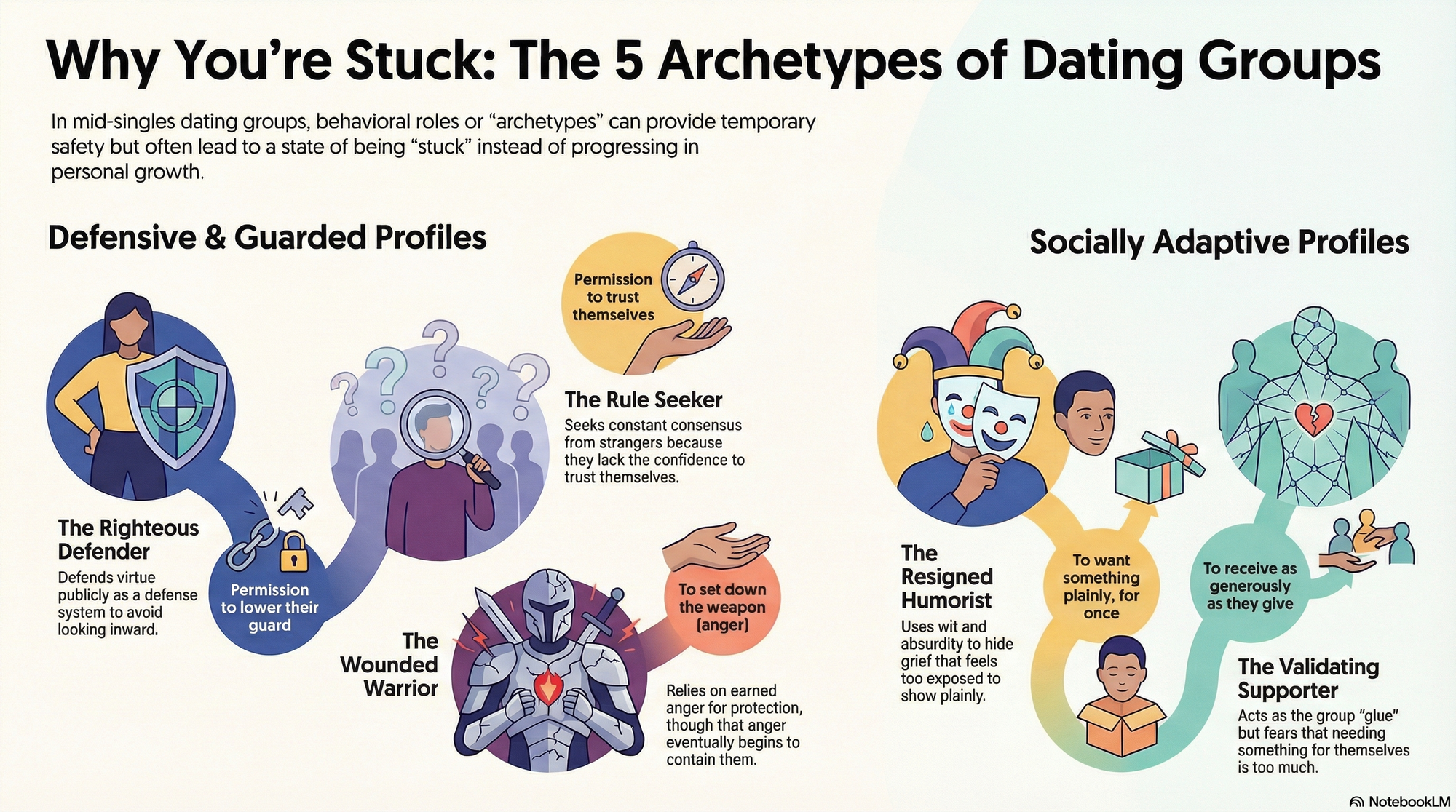
After watching long enough, we started noticing something: the same five kinds of people show up in almost every thread. They respond differently, they need different things, and they're at very different places in their dating lives. Most people can spot themselves in at least one of them - and recognize someone they know in all five.
Here's the part that might sting a little: four of these five types are stuck. One of them is actually moving. And when we tell you which one it is, it might not be who you expect.
Let's meet them.
Type One: The Righteous Defender
Scott
You know this person. You might be this person.
They show up in full force when someone posts something offensive, shallow, or spiritually misaligned. They name the problem. They draw the line. They remind everyone what Christlike behavior actually looks like. And they do it publicly, confidently, and often to significant applause.
In March, the group's most prolific poster was a man who by our count contributed at least five of the month's top fourteen highest-engagement posts. He defended women's worth. He called out spiritual shallowness. He rallied the community around virtue. He invoked scripture. He got hundreds of reactions and hundreds of comments for doing it.
He is the Righteous Defender at his most recognizable - and the community clearly needs him. He fills an emotional role that nobody else is filling. He gives people a shared language for their frustration and a sense that someone is fighting on their side.
Here's what I want to say about this person with genuine respect: the instinct is good. Standing up for virtue matters. Calling out cruelty matters.
But here's the pattern underneath it. The Righteous Defender is spending enormous energy on other people's behavior. He has a finely calibrated radar for shallowness, for bad character, for spiritual immaturity in the opposite sex. And that radar, quietly, is also a defense system. Because as long as the problem is out there - in the dating pool, in the shallow men, in the women who fail to recognize good men - the Righteous Defender doesn't have to look at what's happening in here.
Laurie
I want to add something, because this pattern shows up in women too, and it looks a little different.
For women who've been genuinely hurt, the Righteous Defender mode is protective. It's a way of saying, "I know what's wrong, I can spot it, and I will never let it happen to me again." And that's not nothing. That awareness comes from real experience and real pain.
But there's a cost. When you spend most of your energy identifying what's wrong with the dating pool, you start to see threat everywhere. Every man with preferences becomes the shallow guy. Every post about standards becomes a red flag. The filter gets so sensitive it starts blocking signal along with the noise.
The Righteous Defender is often one of the most intelligent, emotionally aware people in the room. What they need isn't better arguments. What they need is permission to lower their guard long enough to actually let someone in.
Type Two: The Rule Seeker
Scott
This one is the most openly vulnerable person in the group - and often the least aware of it.
The Rule Seeker posts questions. Should I text first? Is it weird to reach out after two weeks of silence? What does it mean when he watches my stories but doesn't message? How long should I wait before suggesting a date?
In March, one Rule Seeker post about whether texting first looks desperate generated 191 comments. Only 39 reactions - meaning people didn't just "like" it. They were compelled to respond, because the question touched a nerve that most members share but rarely voice directly.
The Rule Seeker isn't weak. They're anxious. Those are different things. The anxiety has a very specific origin - they were taught, for years, that following the right rules would produce the right outcomes. Do this, don't do that, be this way, wait for this. And then the outcomes didn't materialize, or they did and then collapsed, and now they're left with the coping strategy - find the rule, follow it, be safe - without the framework that justified it.
So they ask the group. Because consensus feels like protection.
Laurie
What the Rule Seeker is really asking - under every specific question about texting and timing and signals - is: is it safe to want this? Is it safe to reach out? Is it safe to be seen wanting something?
And that question cannot be answered with a rule. Not even a very good one.
For women from purity culture backgrounds, this runs especially deep. Female desire was not something to be acted on. It was something to be managed, suppressed, and offered only within extremely narrow boundaries. Those messages don't disappear just because you left the church or got divorced or downloaded a dating app. They keep running quietly in the background, making perfectly reasonable actions - like texting a man you're interested in - feel fraught with danger.
The Rule Seeker doesn't need a better rule. They need permission to trust themselves.
Type Three: The Wounded Warrior
Laurie
This is the person the group doesn't always know what to do with - and neither does she, half the time.
The Wounded Warrior has been genuinely, significantly hurt. Not just disappointed. Hurt. Divorce. Financial devastation. Betrayal. The particular cruelty of having done everything right and still ending up here, at midlife, rebuilding from rubble.
In March, a post asking whether women profit from divorce and alimony generated 323 comments - the second-highest engagement of the month. It was raw. It was detailed. It was personal. And it gave voice to a large, quiet segment of the group who have been similarly wounded but haven't yet found language for it.
The Wounded Warrior comes to the group to push back. She's not here for platitudes. She's not interested in being told to work on herself or stay positive or trust God's timing. She's been through something real and she needs it acknowledged.
And here's the thing - she's right. It was real. It does deserve to be acknowledged. The anger is not irrational. The pain is not exaggerated.
Scott
But here's where I want to be honest with the Wounded Warrior, because I think she deserves honesty more than she deserves comfort right now.
Anger is useful in the early stages of recovering from real pain. It's actually a sign of life - it means you haven't given up, you still believe in fairness, you still think things could be different. That's not nothing.
But anger has a shelf life. At some point it stops protecting you and starts containing you. The Wounded Warrior who is still relitigating the divorce three, four, five years later - still posting about it, still connecting every dating frustration back to what was done to her - isn't fighting anymore. She's just camping on the battlefield after the war is over.
The bravest thing the Wounded Warrior can do isn't to keep fighting. It's to set down the weapon and figure out who she (or HE) is without it. That's terrifying. It's also the only way forward.
Type Four: The Resigned Humorist
Laurie
This one is the hardest to spot because they're genuinely funny.
They're the ones sharing the memes, making the self-deprecating comments, responding to serious posts with a well-timed observation that makes everyone laugh and diffuses the tension. "Samson had a type." "My dating life? 'Another One Bites the Dust.'" "Comfortably Numb describes my last three dates."
The humor of people who have been disappointed enough times that they've developed a philosophical relationship with it. And I love the Resigned Humorist. They're often the smartest people in the room. They can see the absurdity. They're not deluded.
But humor can be a resting place or a hiding place. And for a lot of Resigned Humorists, it's become the latter.
The 80s song game this month was a masterclass in this. It got the single highest engagement of the month - 361 reactions, 360 comments - because it gave people a low-risk, funny, nostalgic way to express what they couldn't say plainly. "Still Haven't Found What I'm Looking For." "Faithfully." "Waiting for a Girl Like You."
Beautiful songs. Aching songs. And not a single one of them said plainly: I want to be loved and I'm scared I won't be.
Scott
What the Resigned Humorist is really doing - under the wit - is grieving. And they're doing it sideways, through comedy, because straight-ahead grief feels too exposed.
If you're the Resigned Humorist, I'm not asking you to stop being funny. The group needs you. The humor is a real skill, not just a defense mechanism.
But I am asking: when's the last time you let yourself want something without immediately making a joke about it? When's the last time you said, out loud or even just to yourself, "I really want to find someone. Not in a desperate way. Just - I want it. I think it would be great."
Because underneath the humor, that's still there. And it deserves to be said plainly, at least once.
Type Five: The Validating Supporter
Laurie
The Validating Supporter is the glue of the group. They're the "Amen," the "This!," the "Thank you for saying this." They make other people feel seen, they respond to vulnerability with warmth, they keep the emotional temperature of the group from dropping below freezing.
They're also, often, the most quietly unhappy people in the room.
Because here's the pattern: the Validating Supporter has gotten very good at taking care of other people's emotional needs. They're attuned. They're generous. They're present for everyone else's moments.
And they've spent so long being the person who validates others that they've almost forgotten how to be the person who needs something.
When the post defending women's worth gets 337 reactions, the Validating Supporter is in there leaving heart emojis and "we always need good men to stand up for us." And they mean it. Genuinely. But there's also a part of them that's hoping someone will say it directly to them, specifically. Not to "women." To me. Do you see me?
Scott
The Validating Supporter often has a pattern in relationships that mirrors what they do in the group. They are supportive, warm, generous - and extraordinarily good at not asking for what they need. Because asking feels like a burden. Because needing things feels like too much.
What you need to practice - and I say practice because it doesn't come naturally - is receiving. Being specific about what you want. Saying "I need this" without immediately softening it into "but only if it's not too much trouble."
You have been pouring out for a long time. At some point, you have to let someone pour back in.
And Now - The Type That's Actually Moving Forward
Scott
You've been waiting for this. Here's the type.
It's not the Righteous Defender, though their instincts are good. It's not the Rule Seeker, though their honesty is brave. It's not the Wounded Warrior, though their anger is earned. It's not the Resigned Humorist, though their clarity is real. It's not the Validating Supporter, though their warmth is genuine.
The person who's actually moving forward is someone you don't see much in the group. Because they're not in the group very much.
They've done enough of their own work - enough grieving, enough self-examination, enough honest reckoning with what happened and what they actually want - that they don't need the group to regulate their emotional state anymore. They still show up sometimes. They still connect. But they're not there to find out if they're okay. They already know they're okay.
They text when they want to text. Not because the group said it was fine, but because they decided it was what they wanted to do. They have standards not because they've catalogued every possible red flag, but because they know who they are and what they need. They can be vulnerable without catastrophizing. They can be rejected without it confirming their worst fears.
They're not perfect. They still have bad dates and awkward moments and nights when it all feels too hard. But they're showing up as themselves - not as the safest, most acceptable version of themselves. And that's the only version that ever actually connects.
Laurie
You can get there. All five types can get there.
The Righteous Defender just has to be willing to look inward with the same clarity they look outward. The Rule Seeker has to learn to trust themselves more than the consensus. The Wounded Warrior has to be willing to set down the weapon and find out who she is without it. The Resigned Humorist has to be willing to want things plainly, without the joke as cover. The Validating Supporter has to be willing to receive as generously as they give.
None of that is easy. All of it is possible.
And you don't have to do it alone. But you do have to do it. The group, as good and warm and funny as it can be, cannot do it for you.
That's the work. And it's worth doing.
And when you're ready to actually start it, we will be here.
-- Scott & Laurie
Weighing in from the lowest tier of the Celestial Kingdom, where we discovered the most dangerous thing you can do in mid-singles dating is show up as your actual self - and also the only thing that ever worked.