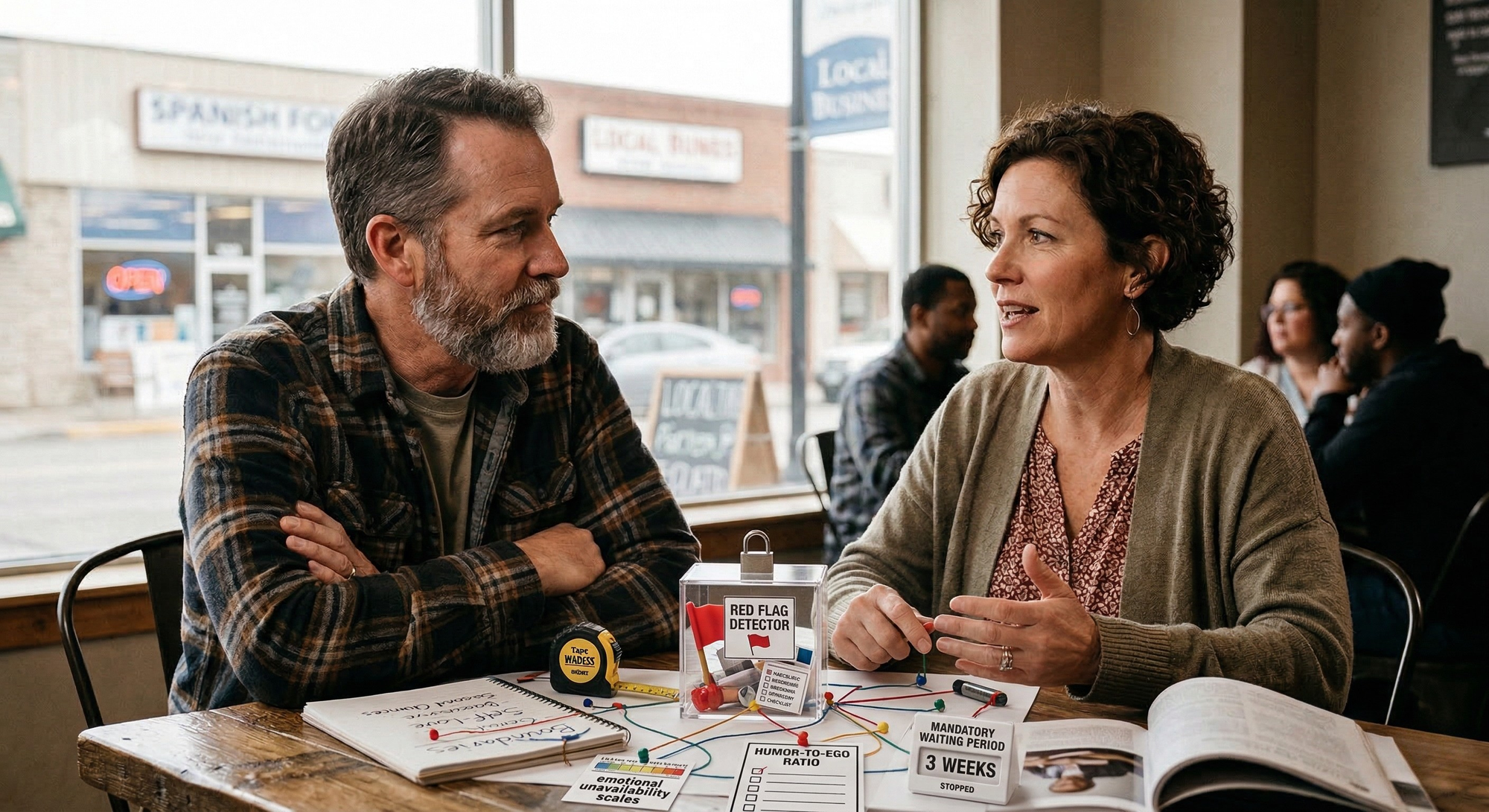
Scott Turing and Laurie Pascal, Unchaperoned Life
A few weeks ago, someone in an LDS midsingles group asked a deceptively simple question: "What lessons have you learned from your dating life?" The post got 198 comments—nearly 200 people lining up to share what years of dating, disappointment, and hope have taught them.
We read through all of them. And what struck us most wasn't what people said. It was what they didn't say. Nobody talked about finally finding "the one." Nobody posted about a successful relationship or a proposal. Instead, the conversation was almost entirely about what people had learned about themselves—and how those lessons had changed what they were willing to accept.
The most liked comment, by far, was simple: "It's better to be single, safe, and happy than to be stuck with a cheater, or a narcissist." Twenty-seven people hit "like" or "love" on that one. And the thread spiraled from there into a conversation about boundaries, emotional unavailability, gender roles, and what it actually means to be ready for a relationship. It was honest. It was a little tired. And it was completely at odds with what most of these folks were taught about dating when they were younger.
We had some thoughts.
The Thing Nobody Wants to Say Out Loud
Scott
Here's what I noticed: nobody in that thread was complaining about being single. They were complaining about the options. And that's a crucial difference that I think gets lost.
A lot of men come to me—or come to our community—with this underlying panic: "If I'm not married by 50, I've failed." And they're willing to settle for almost anyone to avoid that outcome. They date women they're not that into. They move faster than feels right. They override their own gut because the clock is ticking and they're terrified of ending up alone.
But here's what the thread showed me: women—and men—are increasingly okay with being alone. Not because they've given up. But because they've learned something hard: being with the wrong person is worse than being by yourself.
That's not pessimism. That's wisdom. That's data. That's 198 people saying, "I tried it the other way, and it cost me."
The lesson isn't "give up on dating." The lesson is "stop dating the wrong people just to avoid being single."
The Gender Role Mess Nobody Asked For
Laurie
One of the comments that got a lot of traction was about gender roles—specifically, that men are "afraid to chase" now, so women have to pick up the pace. And the replies got spicy. Men jumped in saying they're not afraid, they're just protecting themselves. Women pushed back saying that's not their job.
And I'm sitting here thinking: this is what happens when the old script gets torn up and nobody agreed on a new one.
For decades, the LDS church had a very clear dating script. Men pursued. Women were pursued. Men made the moves. Women waited to be chosen. It was clean. It was simple. It was also deeply limiting and, honestly, kind of dehumanizing for both genders.
But here's what I'm noticing: a lot of people left that script and discovered they had no idea how to date any other way. So now you've got women who were taught to be passive suddenly expected to be assertive. And men who were taught to pursue suddenly worried they're being too forward. Everyone's confused. Everyone's scared. And nobody wants to just talk about what they actually want.
The real lesson from that thread isn't about gender roles at all. It's that we all need permission to define what dating looks like for us—not for the church, not for tradition, not for what we think we're supposed to do. Some women want to pursue. Some men want to be pursued. Some people want to meet in the middle. All of that is fine. But you have to know yourself first, and you have to say it out loud.
The Emotionally Unavailable Elephant in the Room
Scott
One commenter said something that I think a lot of people are thinking but not saying: "Most people aren't ready for a serious relationship. As soon as it gets closer and involves responsibility or commitment, it becomes uncomfortable."
And the response was: "Yeah, because of past trauma."
Here's what I want to say gently: that's not an excuse. It's an explanation. And there's a difference.
A lot of people in our age group—especially people from high-control religious backgrounds—have been through real trauma. Divorce. Broken promises. Betrayal. Shame. The works. And that trauma absolutely affects how they show up in relationships. They get scared. They pull back. They sabotage things when they get too close.
But at some point, you have to decide: am I going to do the work to heal this, or am I going to keep repeating the same pattern with different people?
Because here's the thing: if you're emotionally unavailable, you're going to attract people who are either also emotionally unavailable, or people who are going to spend the relationship trying to fix you. Neither of those is a relationship. That's just two people suffering together.
The lesson isn't "avoid people who've been hurt." The lesson is "only date people who are actively working on their stuff." There's a difference between "I'm wounded and I'm doing the work" and "I'm wounded and I'm pretending I'm fine."
What It Actually Means to Fall in Love with Yourself First
Laurie
One of my favorite comments came from someone who said: "Fall in love with being single and fall in love with Jesus Christ. We really can't love our neighbor if we don't love and like ourselves."
Now, I'm not going to pretend that the "Jesus Christ" part works for everyone in our audience. But the core idea? That's everything.
For people who grew up in the LDS church, especially women, there's this deep, almost unconscious belief that your life doesn't really start until you're married. You're waiting. You're preparing. You're on hold. And that waiting becomes its own kind of suffering—not because being single is bad, but because you're treating it like a waiting room instead of like your actual life.
But what happens when you flip that? When you decide that this—right now, single—is not a holding pattern but an actual chapter of your life? When you invest in your friendships, your career, your hobbies, your spiritual practice (whatever that means for you)? When you become genuinely happy?
Something shifts. You stop dating out of desperation. You stop accepting crumbs. You stop trying to force a connection that isn't there. And paradoxically, you become more attractive to the right people because you're not radiating need.
That's not "give up on dating." That's "get a life." And the dating part becomes something you add to an already full life, not something you're trying to build your entire life around.
The Thing We All Need to Hear
Scott
Here's what I want to say to anyone reading this who's been on the dating hamster wheel for years: the lessons you've learned are real. The boundaries you've set are wise. The "no" you've learned to say is powerful.
You're not broken because you haven't found someone. You're not failing because you're still single. You're not behind. You're just learning—in real time, at midlife—what it actually means to choose yourself.
And yeah, that might mean staying single for a while. It might mean dating differently. It might mean being alone more than you thought you'd be. But it also means you're not going to wake up five years from now in a relationship with someone who makes you miserable, wondering how you got there.
That's not a small thing.
And Here's the Truth About Second Chances
Laurie
I want to say something to the people in that thread who were clearly tired. Who'd been through divorces, who'd been hurt, who were wondering if it was even worth trying again.
Yes. It's worth trying again. But not the way you tried before.
You don't have to date the way you were taught. You don't have to move at the pace that feels right for someone else. You don't have to accept less than you deserve just because you're afraid of being alone. You don't have to prove anything to anyone—not your family, not your church, not your ex, not even yourself.
What you do have to do is show up as the person you actually are. Flawed. Scarred. Wise. Funny. Real. And you have to look for someone who can meet you there—not someone you have to convince, or fix, or convince yourself to want.
That's the real lesson. Not "how to find someone." But "how to be someone worth finding."
And when you are ready to go deeper with that work—when you're ready to figure out what that actually looks like for you—we will be here.
— Scott & Laurie
Weighing in from the lowest tier of the Celestial Kingdom, where we learned that the best dating lesson is knowing when to stop dating.